
A Statement to the Citizens of Sarasota County · Full Transparency
The public record belongs to the citizens of Sarasota — and no press conference can take it back
Months of forensic analysis. Full transparency. Zero dark money. First Amendment rights.
They attacked us because they could not refute the record. Here is who we are, what we did, and why every page is protected under the First Amendment.
Every number we publish comes from Sarasota County's own audited documents. Their press conference refuted none of them.
By Local Government Accountability (LGAI) · Publisher of SarasotaCountyFacts.org
Boston (Kendall Square) · Washington, D.C. · August 2026
TO THE CITIZENS OF SARASOTA COUNTY — This work did not begin in July, and it did not begin with any campaign. In November and December of last year our team began gathering documents and building analysis for studies of local governments nationwide. We began the Sarasota County work in early March, after a Boston-area seasonal resident — someone who has watched this community for years — flagged what he was seeing with his own eyes: a widening inequality gap in which the working people who run this county day to day can no longer afford to live in it. Rent. Groceries. Insurance. The basics. And behind that squeeze, a county government that had spiked its spending upward by more than a billion dollars in less than four years. He had seen enough — and asked whether the numbers matched what he was seeing. They did. And worse.
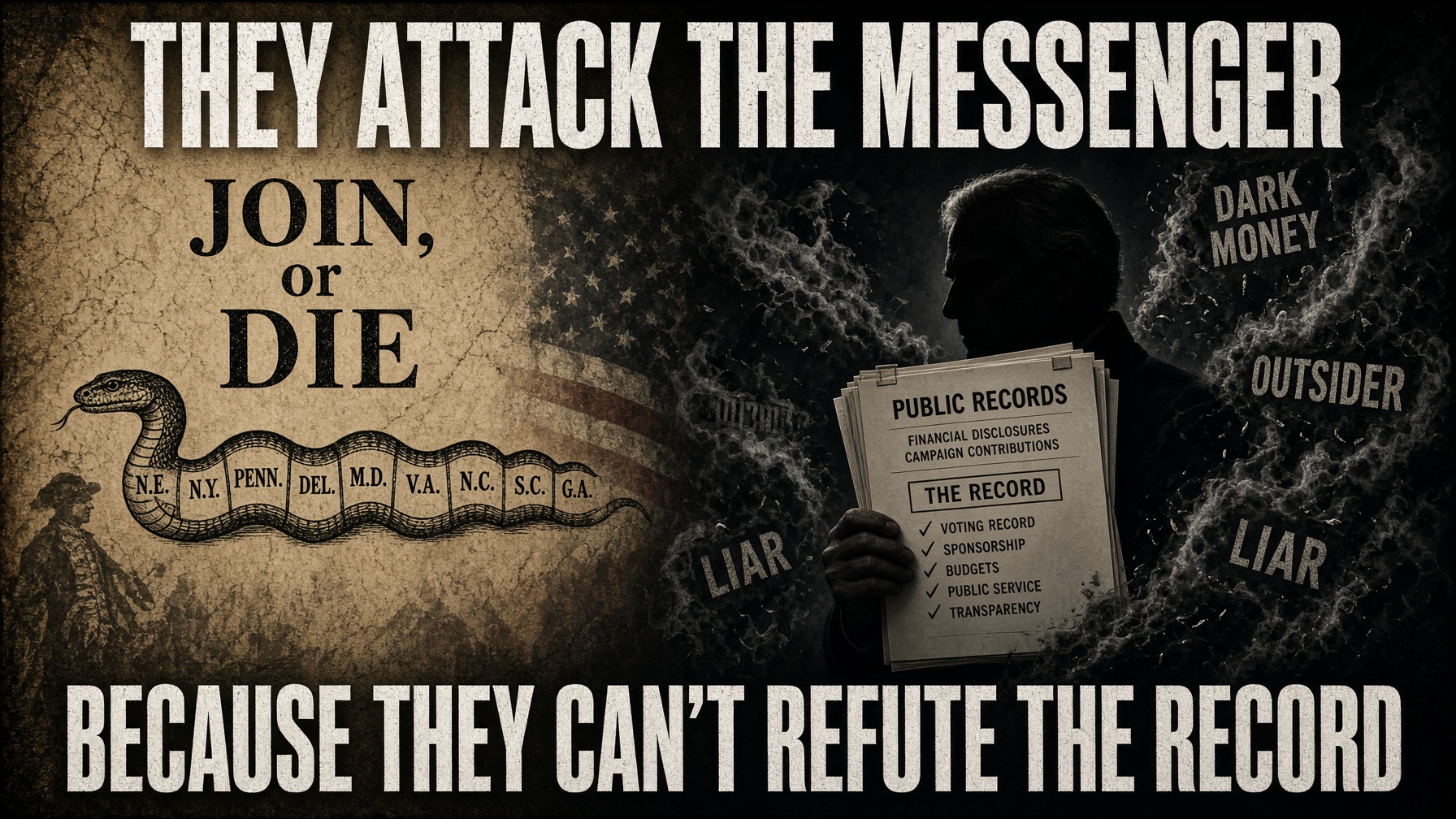
In early July we went public: we launched SarasotaCountyFacts.org and began making local citizens aware of this debt and spending and what it actually means to them and their families in costs, inflation, and the rising price of daily life. In today's world, almost nobody will sit down and read a dozen pages of tables. So we simplified the material and used imagery — at times, parody. Why? Because it works. Satire has been the sharp edge of American political speech since before the Revolution. Benjamin Franklin's “Join, or Die” was persuasion imagery. The founding generation wielded parody, caricature, and anonymous pamphlets relentlessly. The Supreme Court has held — unanimously — that parody of public figures sits at the very core of First Amendment protection (Hustler v. Falwell, 1988). If the parody is protected when an artist draws it, nothing changes when AI renders it. The First Amendment protects the speech, not the paintbrush.
Within a couple of weeks of going public, the work drew coordinated attacks from supporters of Commissioners Joe Neunder and Mark Smith. Those attacks did not bury the numbers. They produced a sharp increase in traffic and a wave of engagement from residents who finally had a clear, verifiable picture of how much spending and debt had been approved, by whom, and with what near-unanimous yes rates.
For the one-minute reader, here is everything you actually need to know:
- Every fact we publish is the county's own record — audited financial reports, adopted budgets, official board minutes. We have been called liars — yet not a single person has pointed to where or how. We have been called “dark money” — pure rhetoric that changes nothing, because we publish facts, and facts do not care who assembled them. You don't hold a press conference of ad-hominem character attacks on the messenger when the math is on your side.
- “Dark money” is a smear, not a legal argument. A 501(c)(4) gives its donors zero tax deduction and sells nothing. It is one of the ordinary, lawful vehicles Americans use to pool resources and speak — the same vehicle used by progressive nonprofits, labor unions, and civic groups every single day.
- Anonymous political speech is as American as the founding itself. The Federalist Papers were signed “Publius.” The Boston Tea Party was planned in secret over fiscal grievances. Free speech is not one American principle among many — it is the First one, the right that guards all the others. Ask yourself: why do they need to know who we are — unless the plan is to punish us for what we found?
- Neunder approved 98.9% of the spending, borrowing, and tax items that reached his desk. Smith approved 99.6% of the spending and debt that reached his. That is not “balanced leadership.” That is a near-complete absence of fiscal stewardship on the one function commissioners actually control: your money.
- We are a bunch of nerds, not a shadow operation — data scientists who watched Elon Musk's DOGE effort surface large volumes of federal spending data at speed, and realized nobody had ever done it systematically for local government, where your property taxes actually live. So we built it from the ground up. Business is booming. We receive inquiries every day from citizens across the country who want their own books examined.
- You only take flak when you're over the target. The attacks started only after the ledgers went public — and got loudest as the primary got closest. We tapped a nerve. Draw your own conclusion.
“The lady doth protest too much, methinks.”
— Shakespeare, Hamlet
When Commissioners Neunder and Smith and their supporters answer a public-record analysis of their own voting ledgers with a press conference full of personal attacks and “dark money” smears — while never producing a single competing number — the old line fits. The more forcefully they attack the messenger, the more clearly they reveal that the minutes themselves are the problem. Excessive protest is not strength. It is the classic tell that the substance is indefensible.
What we actually did — the scale of the public-record work
A single Annual Comprehensive Financial Report (CAFR) for Sarasota County or one of its cities routinely runs 350–400 pages. We reviewed more than twenty-five such reports — the county itself plus the major municipalities — covering data back to 2015 and projections through 2027. That alone is roughly nine to ten thousand pages of audited financial statements, notes, statistical sections, and debt schedules.
On top of the CAFRs sit the board-minute packets. Many individual meeting packets run well over one hundred pages; some exceed several hundred when staff reports, attachments, bond resolutions, and contract exhibits are included. We examined years of those packets for the Board of County Commissioners, along with the supporting debt documents, budget books, and related filings. The total body of material now organized in our database runs to tens of thousands of pages of primary source documents.

A traditional forensic team of four or five analysts working full-time by hand would have required the better part of a year — on the order of eight to ten thousand person-hours — to achieve the same level of systematic coverage, cross-checking, and vote-by-vote transcription. Using algorithms, structured data pipelines, and AI-assisted review, our small team of data scientists completed the core analysis and organization in a matter of months. The same principle that allowed the federal DOGE effort under Elon Musk to surface large volumes of spending and contract data at speed is the principle we applied locally: technology multiplies the reach of a small, disciplined team that is willing to dig into the public record. DOGE worked top-down from Washington. We are the same idea built bottom-up — citizen watchdogs of the money, on behalf of the hard-working families of Sarasota County and of the many other communities across the country where we are applying the same work — starting where your property-tax bill and your cost of living are actually decided: in the decisions of your local government.
The struggle to analyze and assemble those tens of thousands of pages comprises the vast majority of our resources and effort. That work — forensic research, data organization, white papers, and public education on how local government spends the public's money — is exactly the kind of civic betterment and social-welfare activity a 501(c)(4) is designed and intended to perform under IRS rules.
A 501(c)(4) is operated primarily for the promotion of social welfare — the common good and general welfare of the community. Political activity is permitted alongside that purpose. Informing citizens of the fiscal facts of the place they live — and then naming who is responsible when the abnormalities surface — is precisely the pairing this vehicle exists for. The white papers we have published so far (The Lag-Lead Trap, Productivity Parity, The Seven-Pillar Audit Framework, The Florida Laboratory, Fifty Cities Already, The Full Chain, and the Citizens Savings & Efficiency Platform™), the detailed vote-by-vote ledgers, and the fiscal-data analysis are core educational and research work. Accusations that we are somehow operating “illegally” against our IRS designation as a Wyoming 501(c)(4) have no merit. Donors receive no tax deduction. Our primary purpose is the rigorous analysis of public records so citizens can hold their local governments accountable. And here is the part the accusers always skip: even if we were not a 501(c)(4) at all, it would change nothing. Every individual American already holds the full First Amendment right to say everything we have said. That is not a loophole. That is the point of the designation.
The Lag-Lead Trap — the only thing commissioners actually control
Sarasota's political conversation remains mired in conceptual slogans and cultural talking points — development is “bad,” “character of the community,” “outside influence,” and a rotating set of lifestyle issues. Those topics generate heat. They also generate the least actual control by the Board of County Commissioners. And this is typical far beyond Sarasota: local government almost everywhere runs on short, feel-good slogans, because slogans are cheap and ledgers are work. That is, unfortunately, how the system operates. We set out to improve on it — and judging by the public reaction so far, the theory is proving correct.
The one thing commissioners truly control is your money: how much is spent, how much is borrowed, where it goes, and how efficiently it is spent compared with private businesses that have to live inside a real budget or close their doors. Everything else follows from that, or was never in their power to begin with.
When a commissioner votes yes on nearly every spending, bond, and millage item that crosses the desk — a 98.9% yes rate on money for Neunder, including every millage rate and final budget adoption; a 99.6% yes rate on spending and debt for Smith — that is not “balanced leadership.” It is a near-complete absence of fiscal stewardship on the precise function for which they were elected.
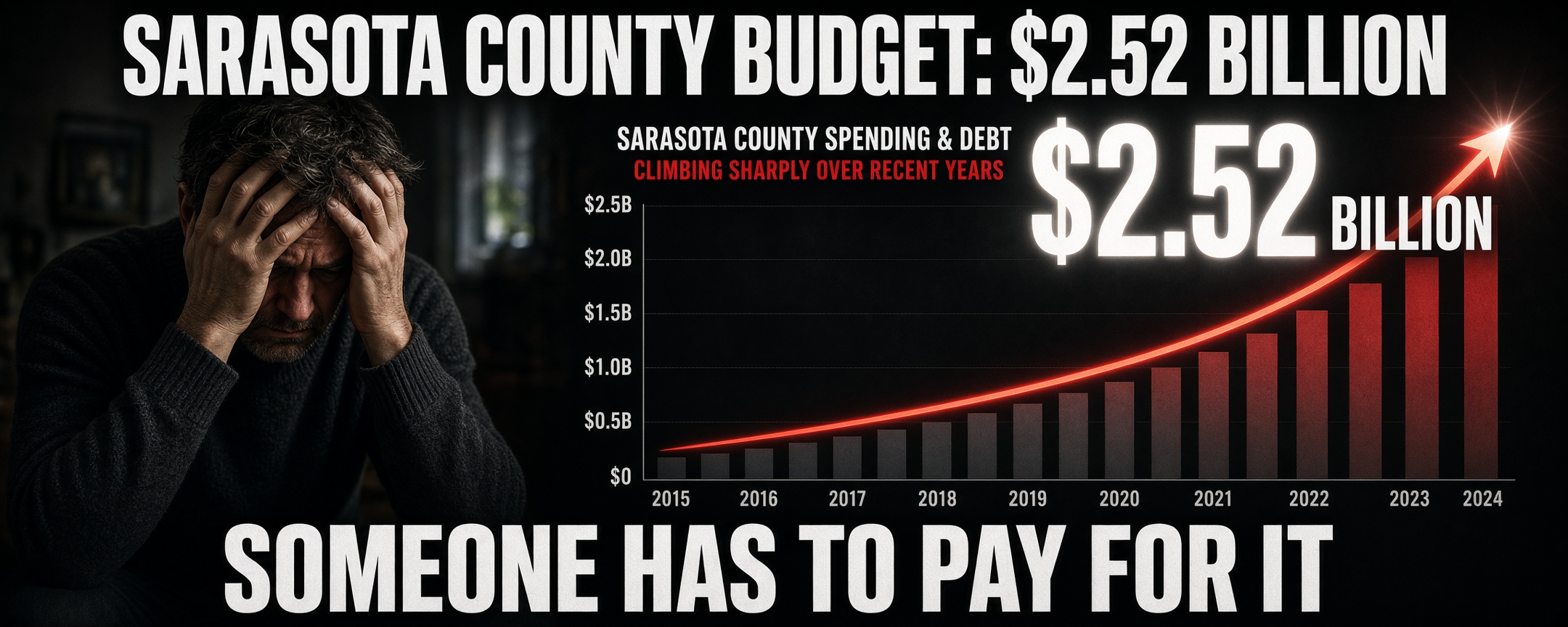
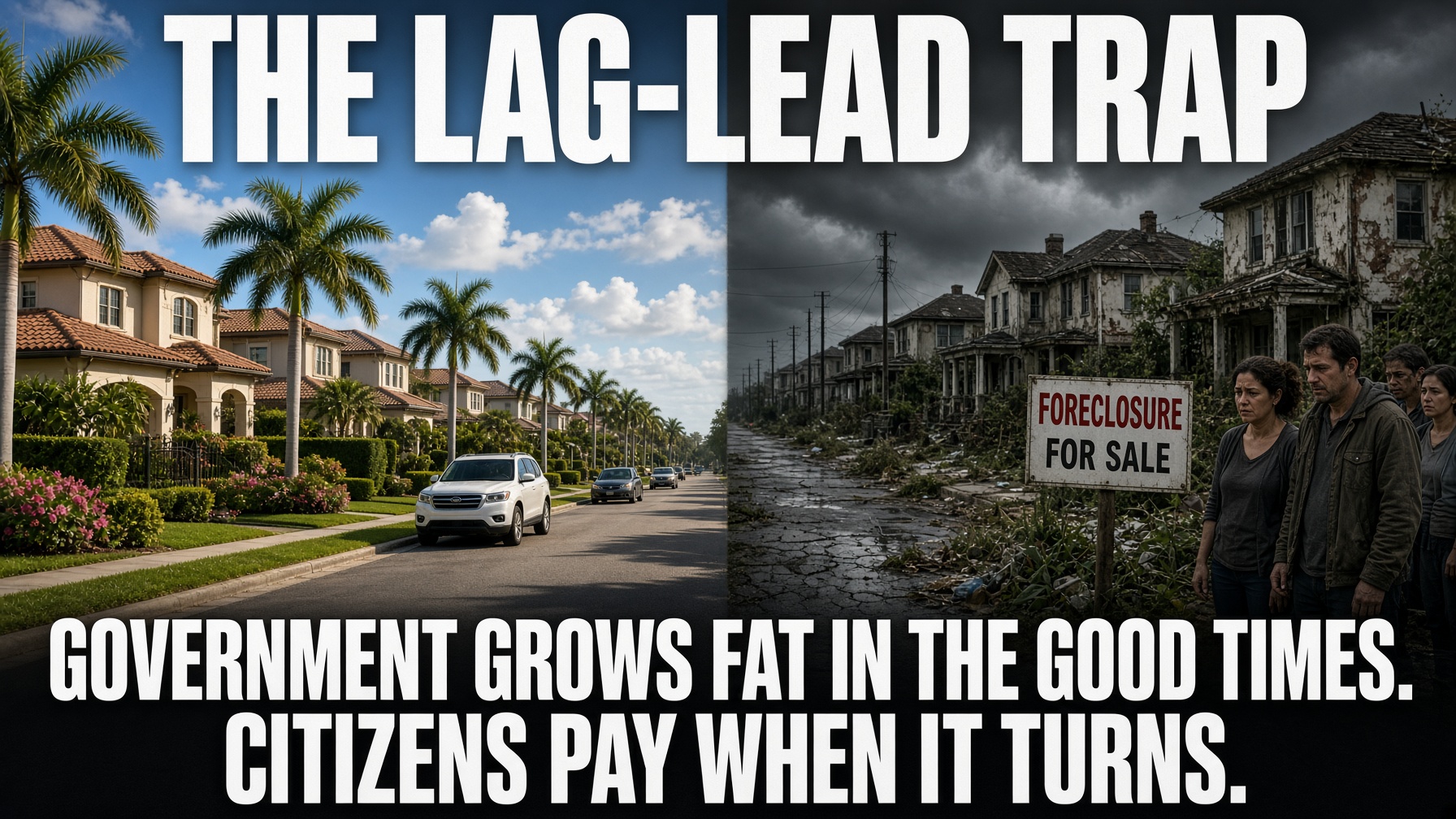
Private-sector productivity in the United States has roughly doubled since 2000. Local-government productivity has barely moved. That gap is paid for, dollar for dollar, by the citizens who fund both sectors. This is the Lag-Lead Trap — the pattern documented in our founding white paper:
- 1. Capital Builds. Free-market actors generate new wealth, new residents, and new tax base.
- 2. Government Expands. Local government grows spending, headcount, and debt on top of that prosperity, acting as if it created the growth.
- 3. The Cycle Turns. Population change, interest-rate pressure, property-tax reform, or simple contraction slows revenue growth while the spending and debt remain structural.
- 4. The Gap Surfaces. Deficits, service cuts, tax increases, or fiscal emergency appear. Detroit is the clearest modern American example of what happens when the lag is ignored for too long. Other cities chose the same path; a smaller number (New York City in 1975 under duress) chose reform because organized citizens forced the political class to confront the math.
High-net-worth residents moved to Sarasota for the climate, the lifestyle, and private opportunity. Local government did not invent that attraction. Yet the response has been to grow the public budget and debt load as if the government itself were the engine of prosperity. When the next downturn arrives — and history says it always does — the lag appears. The private sector has already been restructuring around productivity. Local government, as always, is last to adjust.
The real deficit problem
“We don't have deficits because people are taxed too little. We have deficits because big government spends too much.”
Ronald Reagan
On free speech, anonymity, and the vehicles citizens use to speak
Any citizen, any group of citizens, any Facebook page, any corporation, any nonprofit, or any association may publish research, opinions, and analysis about how elected officials spend public money. The First Amendment does not require a government-approved speaker ID or a donor list before citizens may speak.
“Congress shall make no law… abridging the freedom of speech, or of the press; or the right of the people peaceably to assemble, and to petition the Government for a redress of grievances.”
The men who launched the Boston Tea Party met in secret over fiscal grievances with distant authority. The Federalist Papers were published under the pseudonym “Publius.” The Supreme Court has protected anonymous political speech (McIntyre v. Ohio Elections Commission) precisely because anonymity is a shield from the tyranny of the majority. Citizens United simply confirmed that the government may not ban independent speech because citizens chose to organize as a nonprofit or corporation.
Any Facebook group, any corporation, any civic association, or any 501(c)(4) may do the same thing we have done: examine the public record and publish what it shows. We will not surrender that political right under the First Amendment — not to local incumbents, not to their campaigns, and not to anyone who prefers slogans to the minutes.
Calling this work “dark money” is a rhetorical smear, not a legal argument. It is an intentional manipulative tactic — a classic ad-hominem distraction designed to shift attention from the substance of the public record onto the identity or funding vehicle of the messenger. When the numbers are difficult to refute, the political strategy is to attack the speaker so citizens stop looking at the evidence. A 501(c)(4) gives its donors zero tax benefit. It sells no product. It is simply one of many vehicles available under American law for people who care about an issue to pool resources and speak. The same principle that protects progressive nonprofits, labor unions, newspapers, and anonymous social-media pages protects fiscal-accountability research.
Every day since we began, we have received large volumes of comments and direct messages from citizens who tell us the same thing: they did not know the scale until they saw the ledgers — the excess debt and spending that lands directly on their own lives and the lives of their families. The class divide here is widening. Keep pricing out the people who staff the hospitals, fix the roads, police the streets, and teach the kids, and soon there will be nobody left to run the county. That awareness is the benefit this work has already delivered to the people of Sarasota County. The public record is now open, searchable, and corrected where necessary. The First Amendment protects the right of citizens — and of associations of citizens — to examine that record and publish what it shows. No local incumbent, campaign, or slogan can revoke that right.
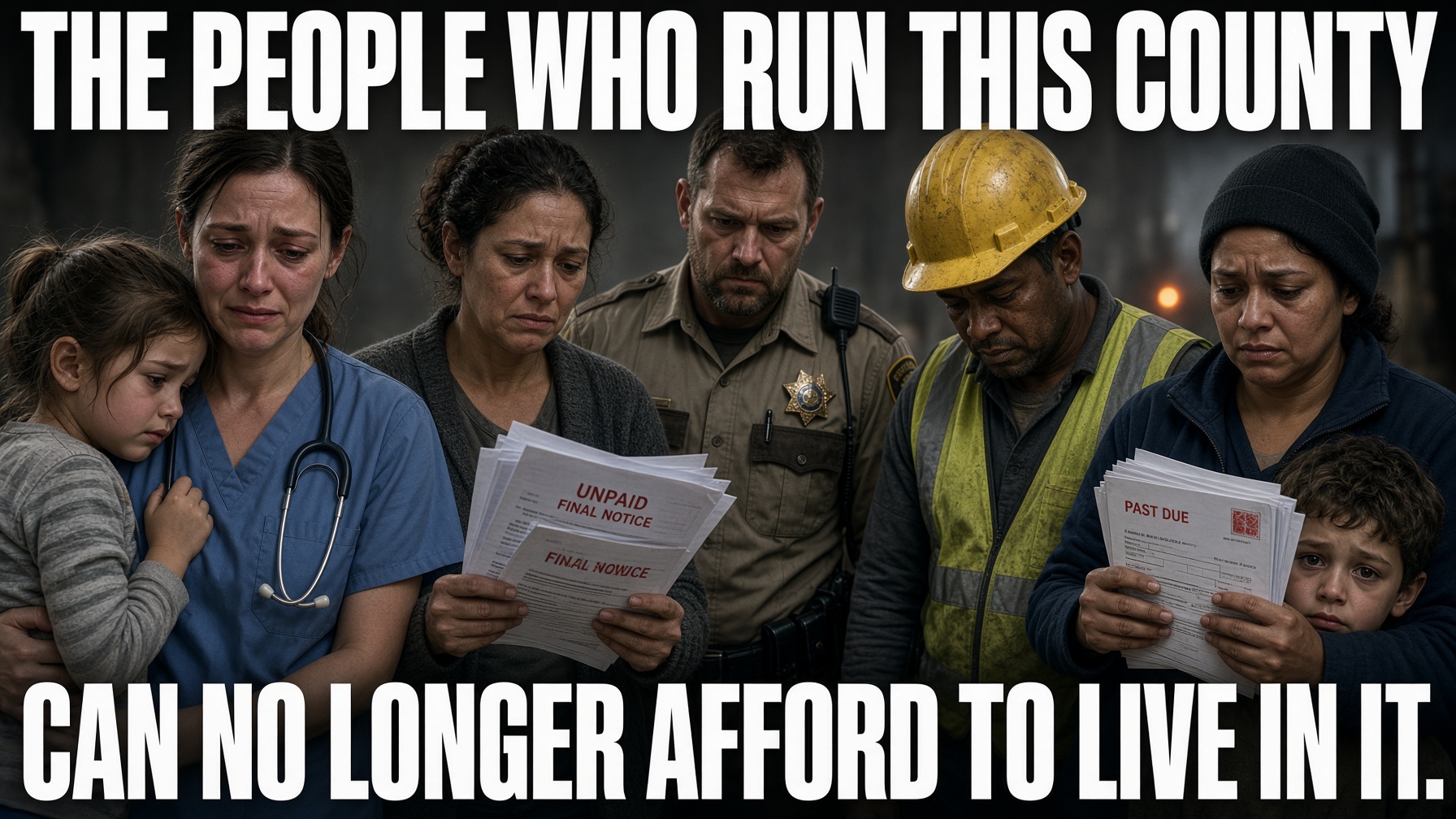
Their impromptu press conference did not answer the minutes or produce competing numbers. It repeated messenger attacks. The record remains public.
Anti-development rhetoric is a trap that expands government power
Growth is the ordinary barometer of a healthy community. While roughly one-third of Sarasota County land is already conserved or protected, substantial additional open and agricultural land remains available for orderly, market-driven development consistent with private property rights. Development creates jobs and brings new taxpayers who share the infrastructure burden. When local government tries to impede or stop growth anyway, growth almost always takes precedence in the end — the government simply ends up settling, incurring enormous legal costs at taxpayer expense, and declaring “victory” over trivial abatements. The taxpayer pays for the fight, and then pays again for the settlement.
Opposition that seeks to use government power to freeze private land in place is an attempt to override the free market and the rights of owners — and of the Americans who want to move here. Sarasota, it should be said, is in a rare and enviable position: the county itself already owns a large amount of undeveloped public land — and it should keep it that way. The issue has never been public conservation. The issue is government control over private land. Those who inherited or bought land decades ago at far lower prices would almost always seek to maximize its value if it were still theirs. Capitalism does not stop because a slogan says so.
There is a deeper problem. Rhetoric that demands ever-greater government control over who may do what with private property is, in substance, collectivist. It concentrates power over land and resources in the hands of the state rather than leaving those decisions with owners and markets. That is the direction taken by Lenin, by Mao, and by every regime that decided the government — not private citizens — should decide the proper use of land and capital. Is that the direction Sarasota citizens actually want?
The same impulse that seeks to expand government permission over private land is the impulse that seeks to expand government permission over private speech. Progressive voices, including Alexandria Ocasio-Cortez, have repeatedly framed inconvenient expression as something that must be managed, intimidated, or chilled in the name of a preferred narrative. The Neunder and Smith campaigns have operated in the same spirit: when the public-record numbers proved uncomfortable, the response was not to contest the minutes but to attack the speaker and attempt to discredit the act of looking. That is not accountability. That is an attempt to control the information environment.
And we already see where that road leads in other free societies. In the United Kingdom, a 41-year-old childminder named Lucy Connolly was sentenced to 31 months in prison over a single social-media post — and the Court of Appeal upheld it. In Australia, a pregnant mother named Zoe Buhler was handcuffed in her own living room, in front of her children, over a Facebook post about a protest — an arrest she livestreamed as it happened. Citizens investigated, arrested, and jailed for posts that officials deemed insufficiently correct. Is that what you want here in Sarasota? Because attacking the speaker instead of the numbers is the first step down that road — and it is the step the Neunder and Smith campaigns and their supporters have already taken. Local support for similar constraints — including the embrace of expansive surveillance tools such as Flock cameras — points in the same direction: more government visibility into private life and less room for dissent.
It already happens in the UK and Australia
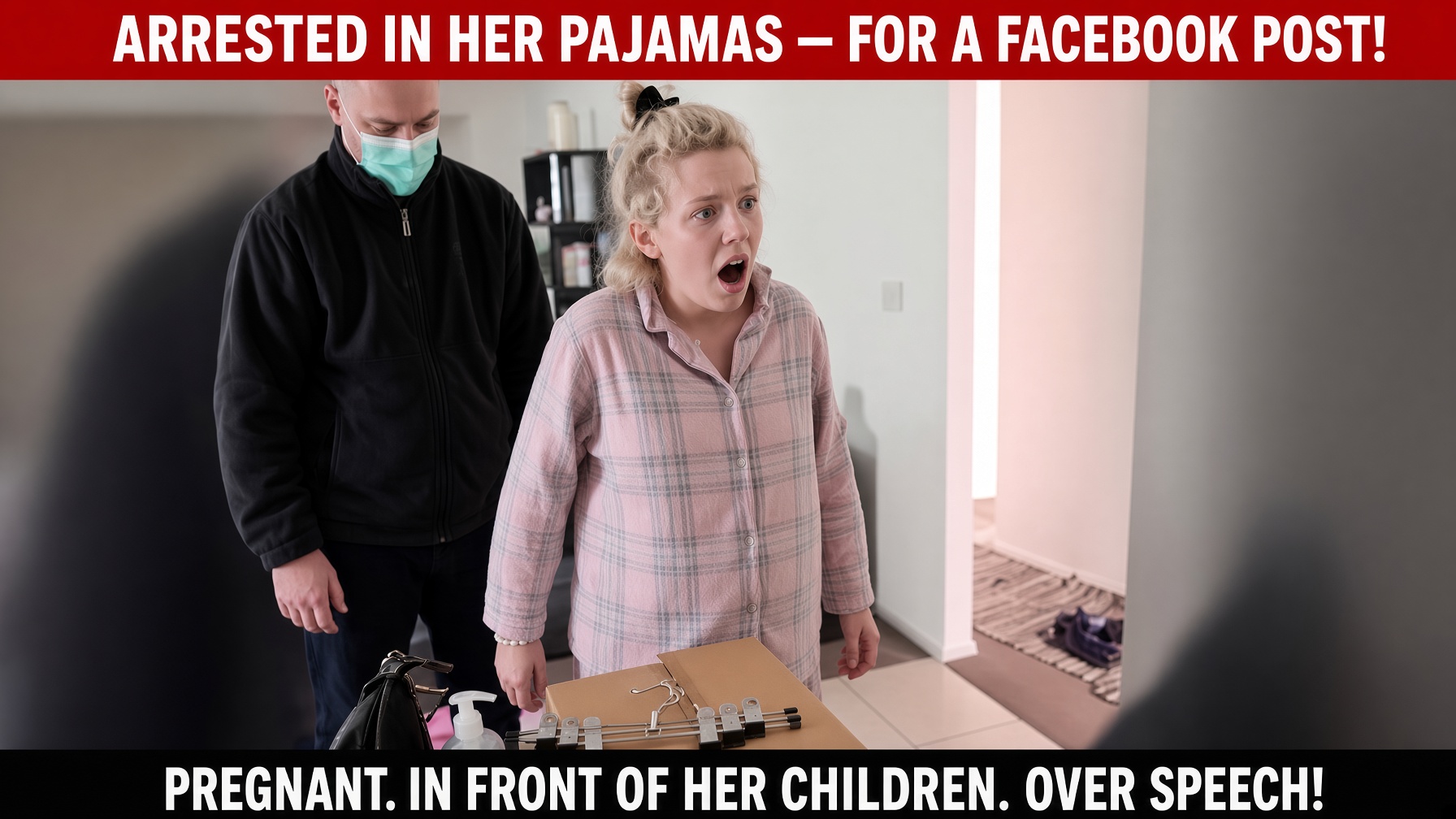
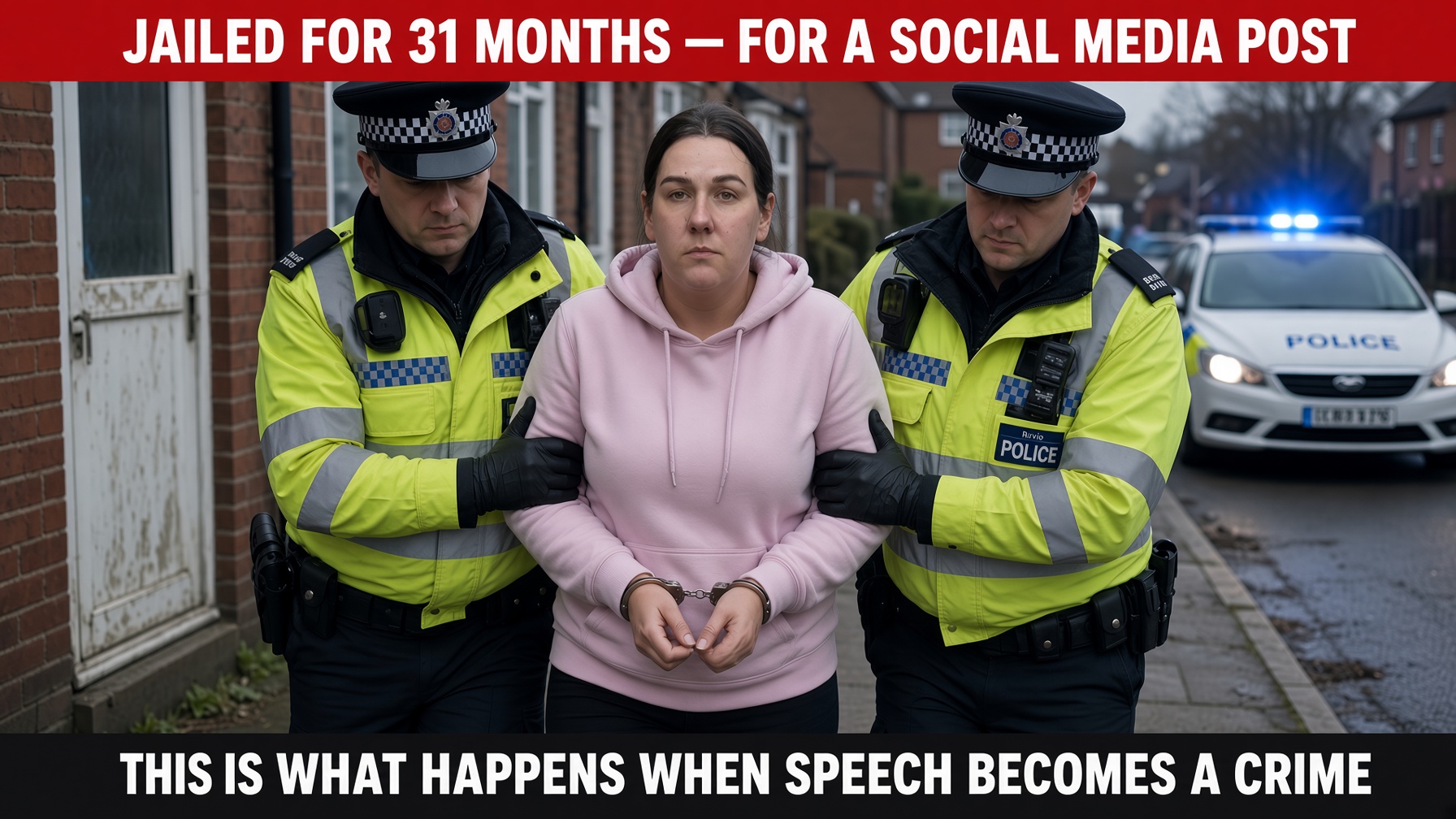
Is this the future you want for Sarasota?
Edward Snowden put the underlying principle cleanly:
Privacy and speech are not optional
“Arguing that you don't care about privacy because you have nothing to hide is like arguing that you don't care about free speech because you have nothing to say.”
Edward Snowden
The anti-development campaign is a distraction and a trap. It invites local government to expand its power over private property while diverting attention from the one thing commissioners already control and have failed to steward: the public's money. The focus should remain on forcing efficiency and discipline in spending, not on handing government more levers over other people's land or other people's speech.
What we already see — and what comes next
Our analysis already indicates that a minimum of 15 percent — and potentially more — of administrative and operational bloat can be identified and cut without sacrificing essential services. On Sarasota County's budget, that is on the order of $300–600 million — savings that would increase the efficiency and quality of government service to citizens, not reduce it. The open question is whether the commissioners will be tough enough to act on it — or whether they will remain beholden to the permanent bureaucracy whose answer, every year, in every budget, is that they need more money. Those savings would translate directly into greater Citizenship Value: the measurable value residents receive through reliable services, responsible taxation, transparent decisions, and institutions that perform as promised.

This Monday we will release detailed, prioritized efficiency recommendations for Sarasota County, grounded in the Lag-Lead analysis and our Citizens Savings & Efficiency Platform™. The goal is clear: increase the value citizens receive while reducing unnecessary bureaucratic cost.
After months of examining the public record we can state with confidence what the incumbents have done. What we cannot do is predict what their replacements would do in office. Campaign-season stances and statements carry close to zero predictive accuracy about what a candidate actually does once seated. We cannot, and do not, guarantee what any challenger will do. Voters should demand proof of performance from every candidate of every party. What the record does show is a near-unanimous pattern of yes votes on spending and debt. Spending other people's money is easy — like parents charging lavish Christmas gifts on the credit card to keep everyone happy for the season. The bill arrives later.
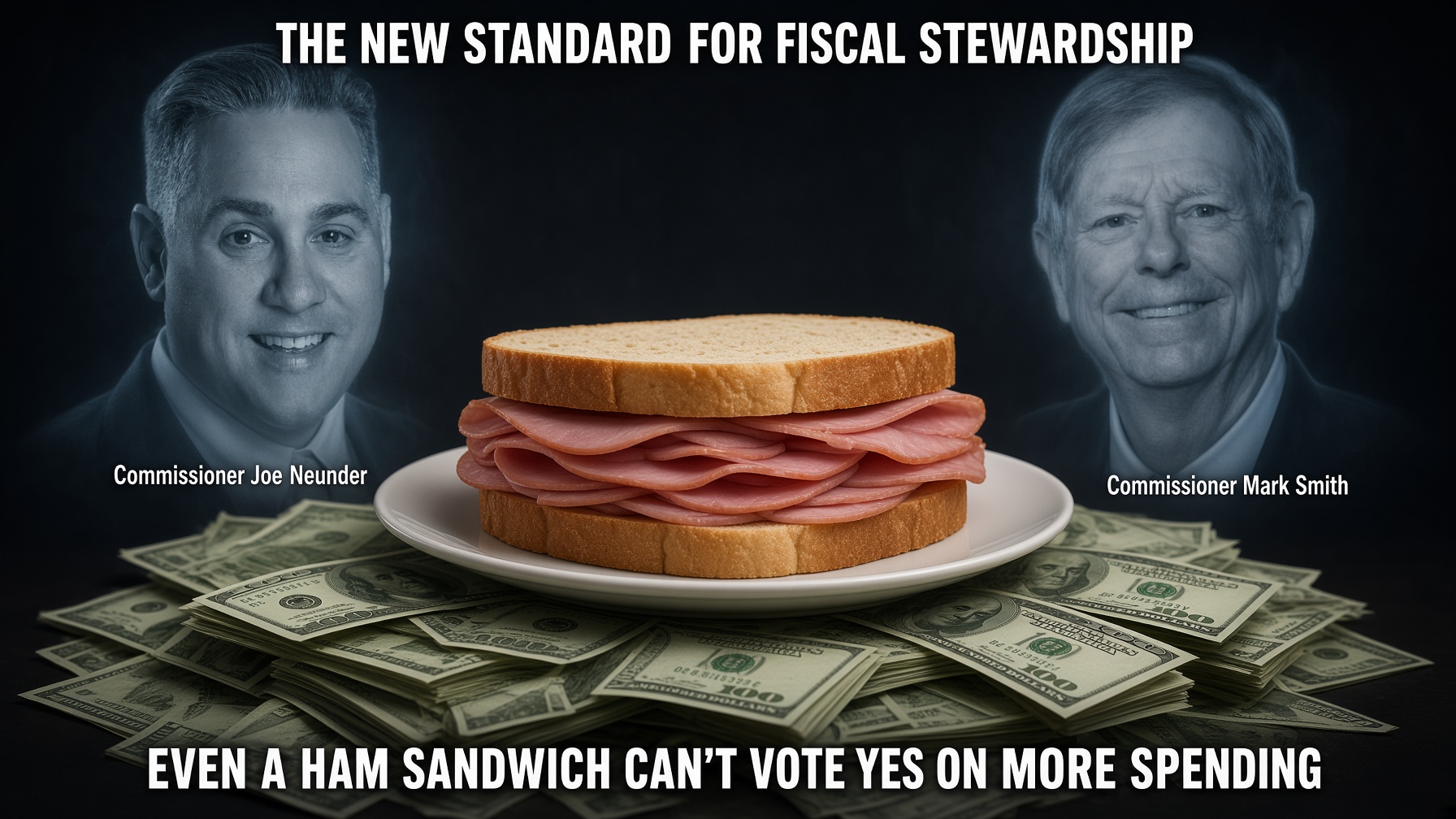
As we stated in our first opinion, The Case, we now formally add to that opinion. The incumbents were so lackadaisical — so reflexively agreeable — in saying yes to everything that crossed the desk that the standard for improvement has fallen, quite literally, to comedy:
The Ham-Sandwich Standard: at this point, after months of fact-finding, even a ham sandwich running against the incumbents would be preferable — because at least the ham sandwich cannot vote yes on any more spending.
Closing
Local government exists to manage the public's money with discipline. Economics — not slogans, not scare tactics about “outsiders,” not vague mailers that promise everything and control almost nothing — is the only thing it is actually responsible for.
We did the work. Tens of thousands of pages of public records are now organized and available. The numbers are public. The First Amendment protects the right of Sarasota citizens — and of anyone who chooses to help them — to examine those numbers and speak about what they show. The Lag-Lead Trap is real. The only levers that matter are the ones commissioners already hold.
That is not a problem for us. That is the entire point.
— Local Government Accountability (LGAI)
SarasotaCountyFacts.org · Boston (Kendall Square) · Washington, D.C.
Primary links for readers
- Neunder voting record → sarasotacountyfacts.org/neunder
- Smith voting record → sarasotacountyfacts.org/smith
- Complete vote-by-vote ledger → sarasotacountyfacts.org/ledger
- Fiscal data & charts → sarasotacountyfacts.org/fiscal-data
- Our original opinion → The Case
- Affordability analysis → Built for Retirees, Unaffordable for Workers
- August 7, 2026 formal correction press release → Correction: We Got the Numbers Wrong
- Full research library at localgovtinstitute.org
Keep Reading: The Full Investigation Library
Everything below is documented from the public record. Each opens in a new tab.
Neunder & Smith together — the record they built as a board
The Case: A Fiscal-Accountability Review
The full indictment in one place. Record budgets, record debt, and the two commissioners who voted yes on virtually all of it — every claim footnoted to the county's own documents.
Read it →
Your Family of Four's Share Is Now $24,004 a Year
Neunder and Smith voted yes on every dollar. This is what the adopted budgets and long-term obligations cost one household — charted from the county's own CAFRs.
Read it →
The Vote Ledger: Every Money & Debt Vote, Catalogued
227,637 entries. Every record budget, every bond, every millage vote — searchable, sourced to the official minutes. This is the database the press conference could not refute.
Read it →
$876 Million: The Largest Fiscal Expansion in the Modern Record
In under four years the county added $876 million in new debt and spending growth — more than any comparable stretch in its modern history. Both incumbents approved it.
Read it →
Built for Retirees, Unaffordable for Workers
Five essential workers, four household budgets, one conclusion: the people who staff the hospitals and teach the kids can no longer afford the county they keep running.
Read it →
Developer Dollars: Who Funds Sarasota's Commissioners
Follow the campaign money — who gave it, what came before the board afterward, and how the votes went. All from public campaign-finance filings.
Read it →
The $21 Million Boatyard: How the County Paid Double for 2 Acres
The county paid roughly twice the appraised value for a two-acre boatyard. The paper trail — appraisals, votes, and closing documents — is all here.
Read it →
'We're on a Path to Destruction': The Commissioner Who Tried to Stop It
One sitting commissioner said it out loud from the dais. What Tom Knight warned about, in his own words — and what the board did next.
Read it →
Joe Neunder alone
The Neunder File: 866 Yes Votes on Money Items
His complete voting record on spending, bonds, and millage — near-100% yes, catalogued vote by vote from the official minutes.
Read it →
The 'Small Government' Promise vs. The Record
He campaigned on small government. Sarasota now funds the 5th-biggest general-government overhead of Florida's 66 counties. See the receipts.
Read it →
The Pinocchio Award
Campaign claims, set side by side against the votes actually cast. The gap between the two earns the trophy.
Read it →
Why Joe Has Gotta Go
The case against the incumbent in District 4, condensed — spending, debt, and the votes he hopes you never read.
Read it →
Mark Smith alone
The Smith File: 713 Yes Votes on Money Items
99.6% yes on spending and debt. His complete money-vote record, catalogued from the official minutes.
Read it →
Sargent vs. Smith: Everything District 2 Voters Need to Know
The full head-to-head — records, funding sources, and public statements of both District 2 candidates, side by side.
Read it →
Mark Smith Stood Alone for the $7.5 Million 'T-Shirt' Grant
Even his own colleagues voted to claw back $7.5 million in hurricane-recovery money from a developer-tied startup that had raised nothing. Smith was the only vote to keep it flowing.
Read it →
Rejected 4-1: The Plan to Let Developers Rebuild Bigger
Smith was the only yes. His own colleagues killed the higher-density condo-rebuild amendment 4-1 — what it would have allowed, and who wanted it.
Read it →
The Smith Spending Fire
Four years of yes votes, visualized. Watch the spending curve climb with his name on every approval.
Read it →
Why Mark Has Gotta Go
The case against the incumbent in District 2, condensed — 713 yes votes, the lone-vote moments, and the record he'd rather not run on.
Read it →
What Has Commissioner Mark Smith Accomplished for You and Your Family?
A simple question, answered from the record. Spoiler: the ledger does most of the talking.
Read it →