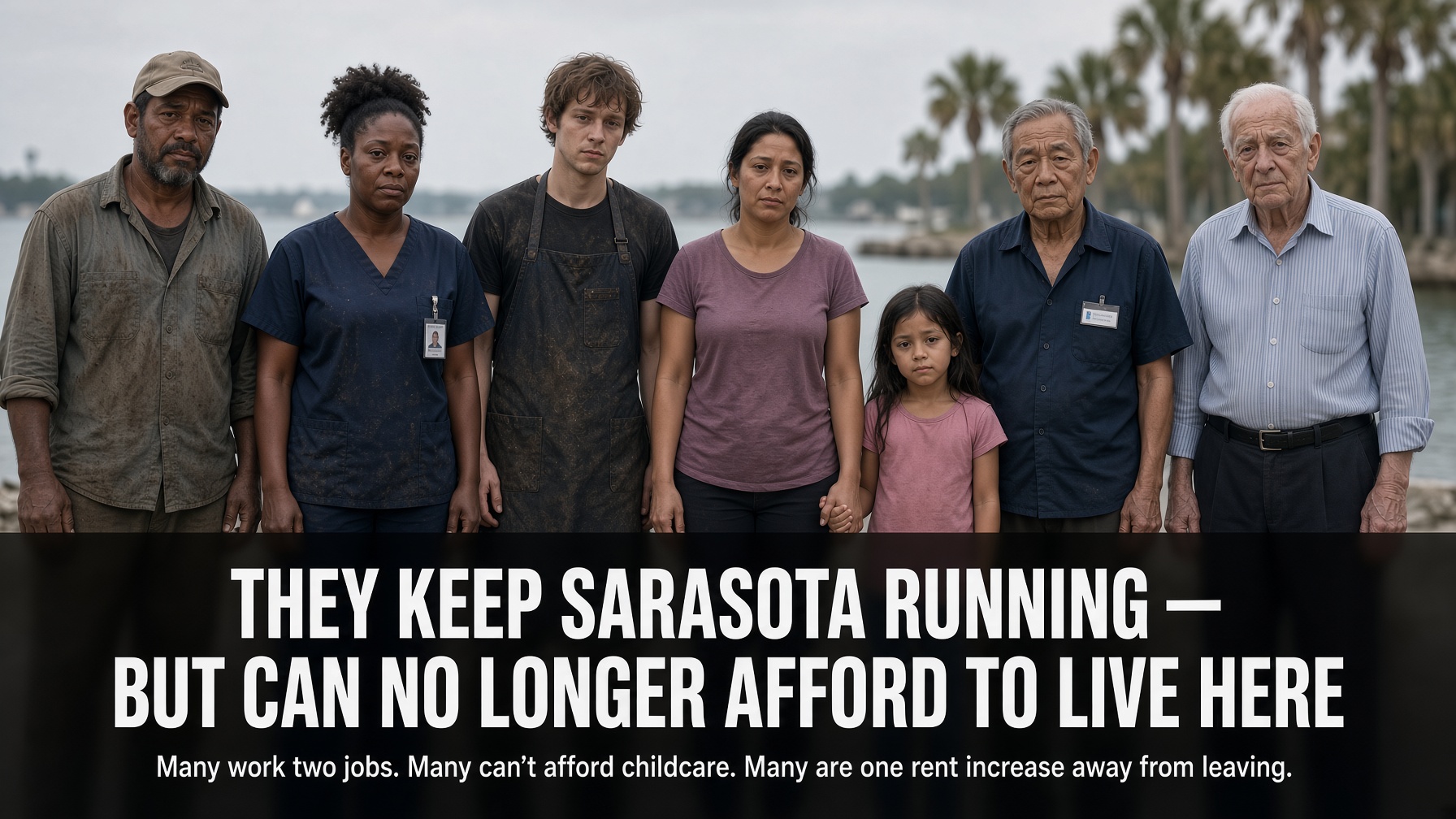
How record spending, rising debt, and resistance to workforce housing are pricing out both the people who work in Sarasota and the fixed-income retirees who already live here.
Opening: The Two Sarasotas
There are two Sarasota Counties.
One is the Sarasota of waterfront estates, seasonal residents, high-end retail, and cultural institutions. It is prosperous, low-crime by large-county Florida standards, and increasingly expensive. The other is the Sarasota of the people who keep the first one running: the CNAs in the retirement communities, the hotel housekeepers, the landscapers, the cooks and servers, the grocery clerks, the construction laborers, the convenience-store workers, and the entry-level public-safety employees. For this second group, the same county is becoming structurally unaffordable.
This is not a story about personal failure. It is a story about arithmetic. Rapid growth in local government spending and debt raises the overall cost base of living here. Resistance to policies that would increase lower-cost housing supply tightens the housing market further. And the widely cited "median income" numbers mask the reality that a significant portion of higher incomes belongs to people whose money did not come from local wages at all.
We have spent months assembling the fiscal, demographic, public-safety, health-ranking, and cost-of-living data that document this divide. The purpose of this report is to place those facts in front of citizens with enough clarity and volume that the trajectory can no longer be dismissed as anecdote.
The Spending Explosion
In a remarkably short period, Sarasota County's total budget moved from under $1 billion to $2.52 billion. The scale of the increase is not incremental. It is transformative.
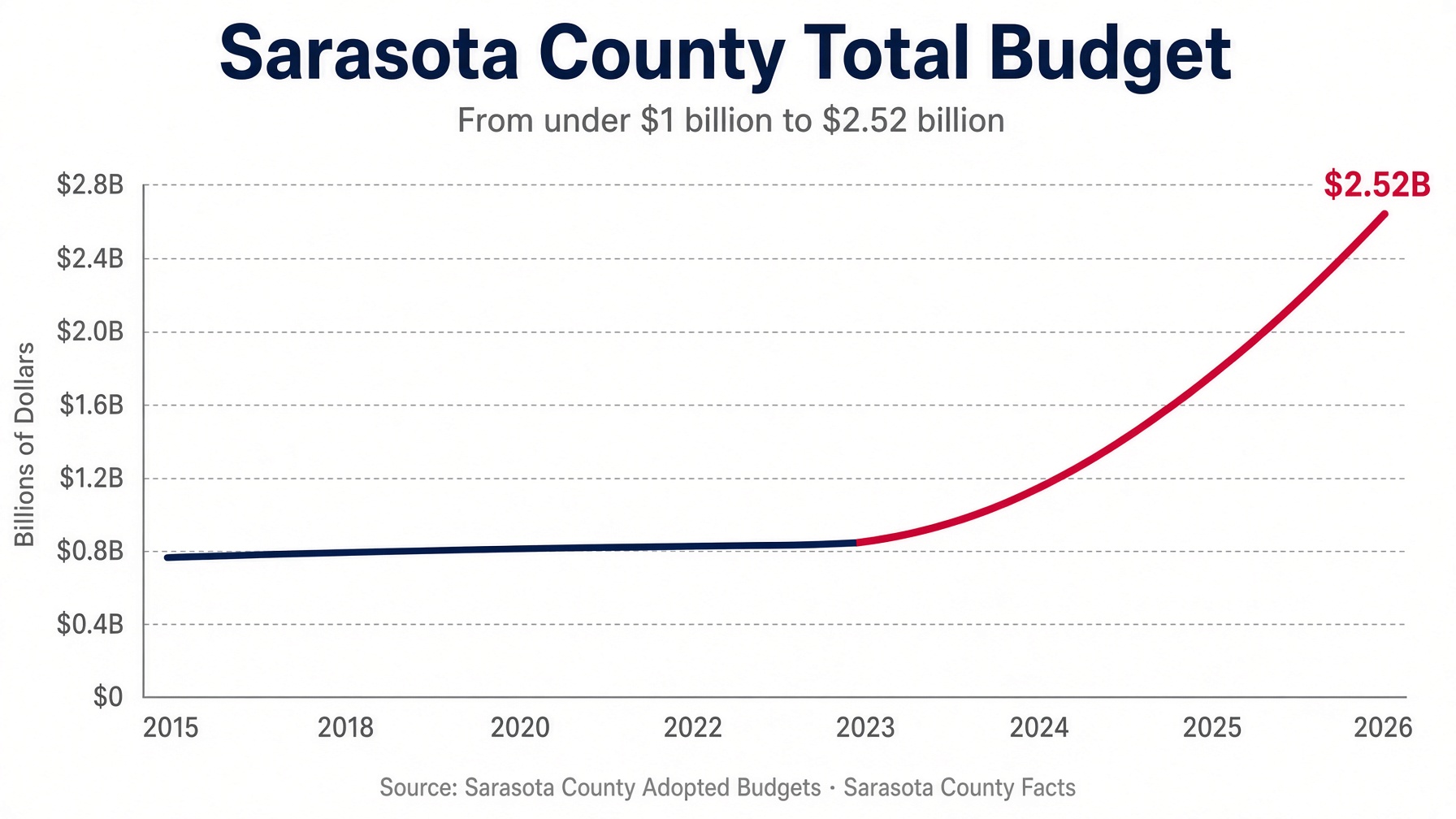
Sarasota County's total adopted budget, 2015–2026. Source: Sarasota County Adopted Budgets.
The Sheriff's Office budget alone rose into the $221–224 million range for FY2026. County Emergency Services / Fire Rescue stands near $178.6 million, with the Fire-Rescue assessment component alone at approximately $77.1 million. When the police budgets of the City of Sarasota (about $50.6 million), North Port (about $39.9 million), Venice (about $14.6 million), and Longboat Key (about $4.6 million police + substantial fire) are layered on top, the combined geographic public-safety burden reaches the mid-to-high hundreds of dollars for every resident.
Those two missions deserve separate ledger lines. Law enforcement and corrections — the Sheriff's Office (including jail operations) plus the four municipal police departments — account for roughly $330 million of that combined burden. Fire/EMS — the ambulance and the fire truck — accounts for roughly another $178.6 million at the county level alone, before municipal fire budgets are added.
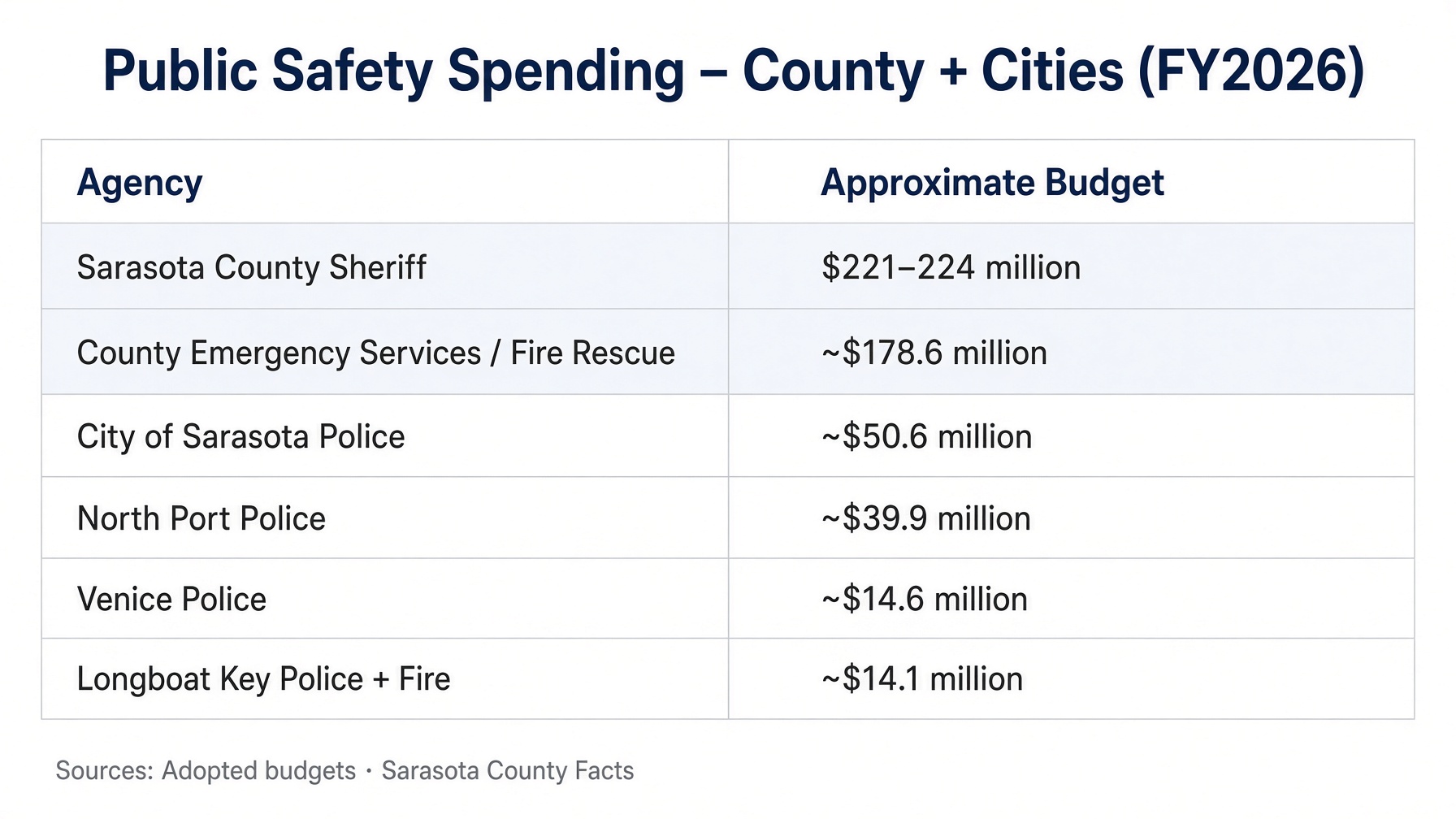
Public-safety spending by agency, county and cities, FY2026. Source: Adopted budgets.
Large government spending increases do not stay on a spreadsheet. Over time they translate into higher property-tax requirements, utility rates, fees, and the general cost of operating a household in the community. Debt service must also be paid. The people who feel this pressure most acutely are those whose incomes are fixed by local labor markets rather than by investment portfolios or out-of-state pensions.
Record spending growth is not free. It is paid for, eventually, by every household — including the households least able to absorb the increase.
The voting record that produced this trajectory belongs to the full Board of County Commissioners. The consequences will outlast any single election cycle.
Crime Results Versus Cost
Sarasota County's crime outcomes are strong by large-county Florida standards. Violent crime has fallen dramatically over the long term (approximately 63% since 2009), and the county ranks as the third-safest among Florida counties with populations above 250,000. The City of Sarasota Police Department recorded an 18% overall crime decline in 2025, the third consecutive year of improvement. Hold those two lines side by side: violent crime has fallen roughly 63% since 2009 while public-safety spending has risen sharply — the crime curve and the cost curve are moving in opposite directions.
Technology has played a visible role. The City of Sarasota alone operates approximately 57 automated license-plate readers. The Sheriff's Office has expanded its own Flock/ALPR network, including installations on traffic poles. Agencies credit these systems with faster suspect identification. Public reaction has been mixed, including reported vandalism of cameras and ongoing privacy concerns.
The cost side of the ledger, however, is rising faster than population. When police, jail, prosecution, and Fire/EMS are combined, the per-resident burden is no longer modest. Citizens instinctively separate "keeping the bad guys away" from "sending the ambulance and the fire truck." Both are necessary. Both are expensive. Only one is primarily about crime control.
The Wage Reality the "Median Income" Hides
Official income statistics for Sarasota County are frequently used to paint a picture of broad prosperity. Those statistics are structurally misleading for understanding the working population.
A substantial share of higher reported incomes belongs to retirees and seasonal residents whose earnings, pensions, and investment returns originate outside the local economy. The wages actually paid to the people who staff the hotels, hospitals, restaurants, retail stores, landscaping companies, and construction sites tell a different story.
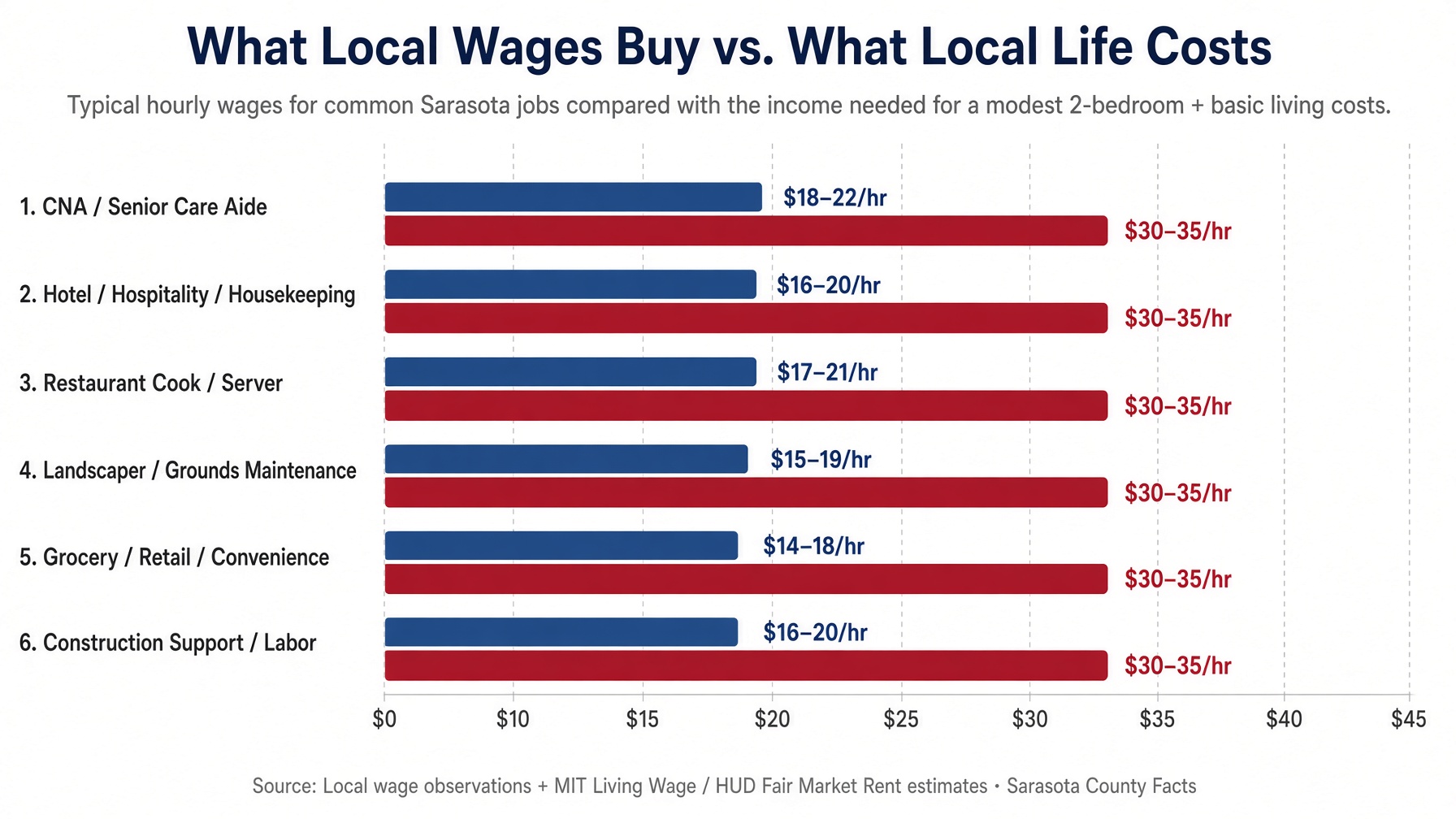
What local wages buy versus what local life costs, six common occupations. Source: Local wage observations, MIT Living Wage, HUD Fair Market Rent estimates.
The "median income" number that gets repeated in economic development talking points is not the wage of the CNA, the landscaper, or the restaurant worker. It is heavily influenced by people whose money never came from a local paycheck.
A traditional single-earner household with a stay-at-home parent, or even many dual-earner service and care households, faces a structural shortage. The common adaptations are already visible: multiple adults sharing a two-bedroom unit, delaying or forgoing children, or leaving the county entirely.
Where These Numbers Come From
The "$30–35 an hour needed" figures are not guesses. They come from the same cost lines Sarasota County Facts has published and sourced throughout this site: a locked $2,119-a-month modest two-bedroom rent, USDA-based grocery costs, published health-insurance and transportation lines, and each household's share of what county government actually spends. Put those bills against real local paychecks and the arithmetic speaks for itself — tap any household below to see the full month, line by line.
Housing Policy and the Live Local Act
While the cost base has risen, county leadership has resisted key provisions of Florida's Live Local Act — the state law intended to increase the supply of affordable and workforce housing. In a market already characterized by high prices and limited lower-cost inventory, restricting additional supply has a predictable effect: it accelerates the replacement of working and generational residents with higher-income and seasonal buyers.
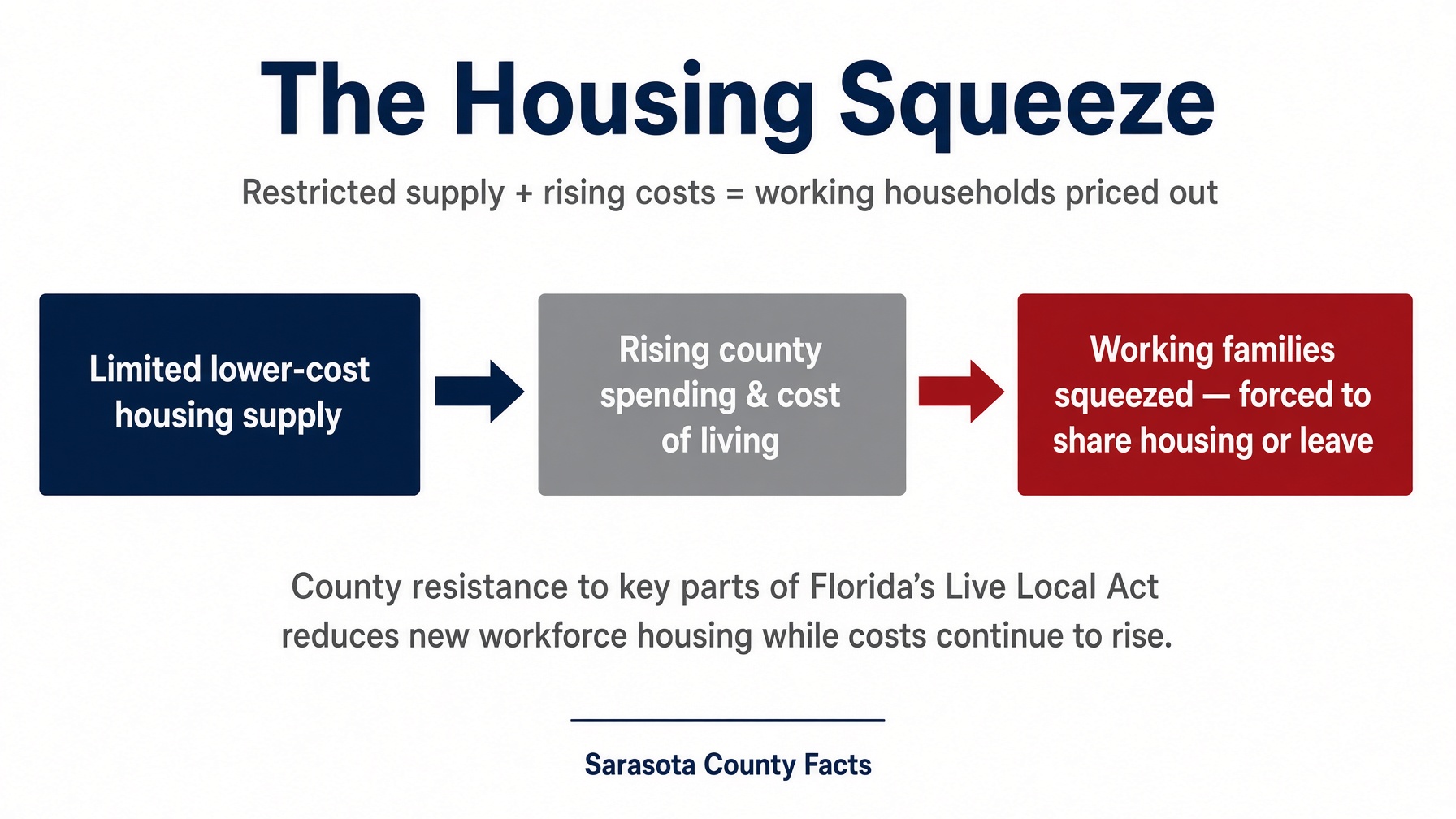
The housing squeeze: restricted supply plus rising local costs prices out working households. County resistance to key parts of Florida's Live Local Act reduces new workforce housing options while costs continue to rise.
The housing market itself is showing signs of softening in many Florida segments — elevated inventory and selective price adjustments. If a broader correction arrives while local government costs and housing restrictions remain elevated, the pressure on working households will intensify, not ease.
Land, Development, and the Concrete Reality
Approximately 33–34% of Sarasota County's land is already protected through conservation purchases, easements, and related programs — a relatively high share. Developed land stood near 30% in baseline analyses, with unprotected agriculture around 13%. The City of Sarasota itself is roughly 95% developed.
The remaining developable land is under intense pressure. Large-scale residential communities continue to appear, generating the traffic, infrastructure, flooding, and wildlife concerns that dominate local conversation. The political conflict is real because the land arithmetic is real: once the remaining open land is entitled and built, the option to preserve a different balance largely disappears.
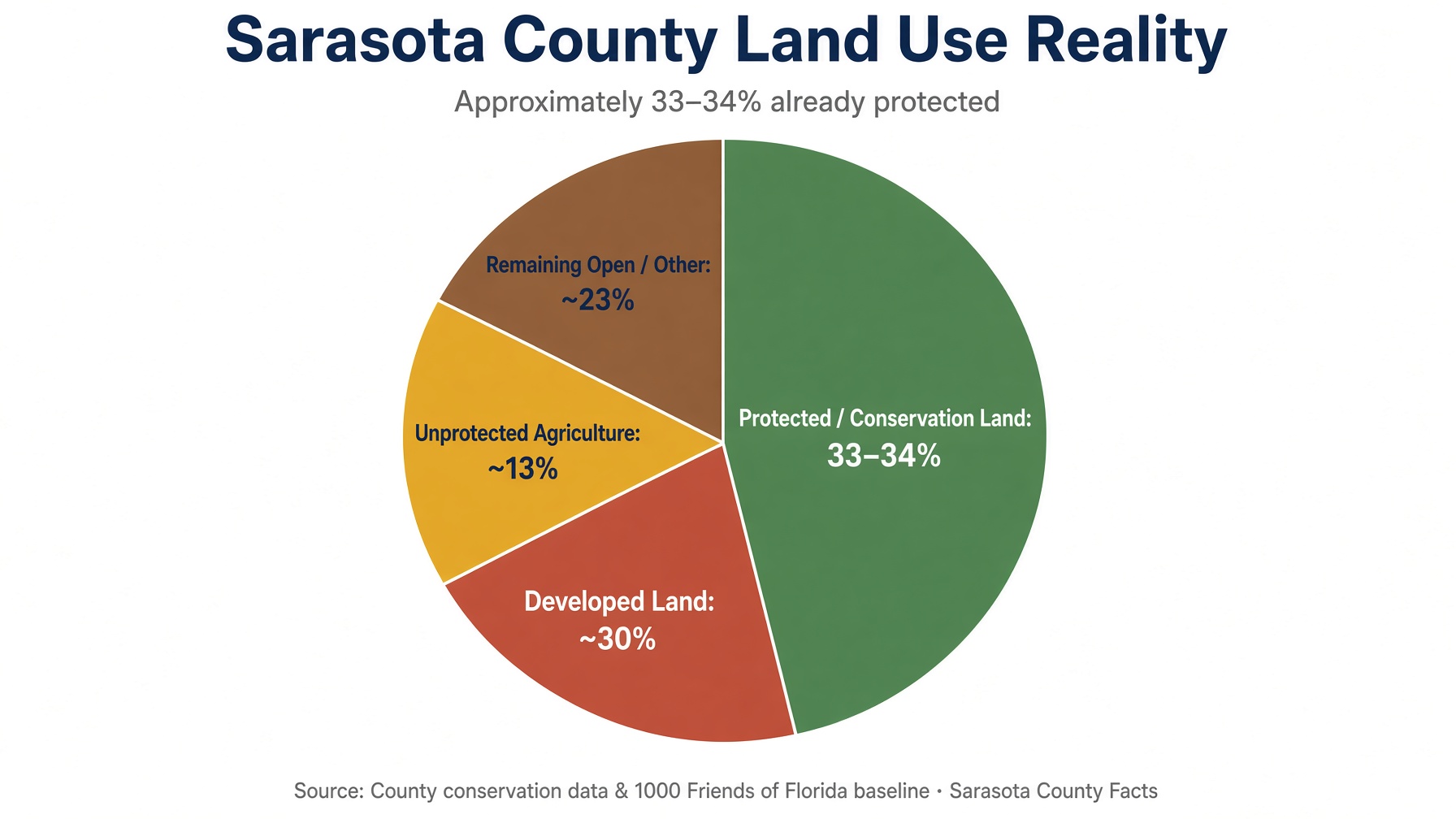
Sarasota County land use: roughly a third of the county is already protected. Source: County conservation data and 1000 Friends of Florida baseline.
The Safety-Net Evidence
The stress on working households is measurable.
All Faiths Food Bank, the primary hunger-relief organization serving Sarasota and DeSoto counties, provided more than 20 million meals and reached more than 80,000 people in a recent year. It operates or supplies roughly 725 distribution points each month. Demand has continued to rise. These are not abstract statistics. They are the volume of food required to keep households that are already working from going hungry.
From the 2025 County Health Rankings and related data:
- Sarasota ranks near the top nationally on several physical-health measures — on poor physical health days it places approximately #75 out of roughly 3,195 counties nationwide, among the best in the country.
- High-school completion is strong.
- Access to exercise opportunities is high.
- Yet severe housing problems and the uninsured rate place the county in the weaker national quartile.
- Income inequality and racial gaps in life expectancy, premature death, and homicide remain material internal weaknesses.
- Children in poverty and single-parent household rates, while not the highest in Florida, are high enough to register as persistent stress indicators for the working population.
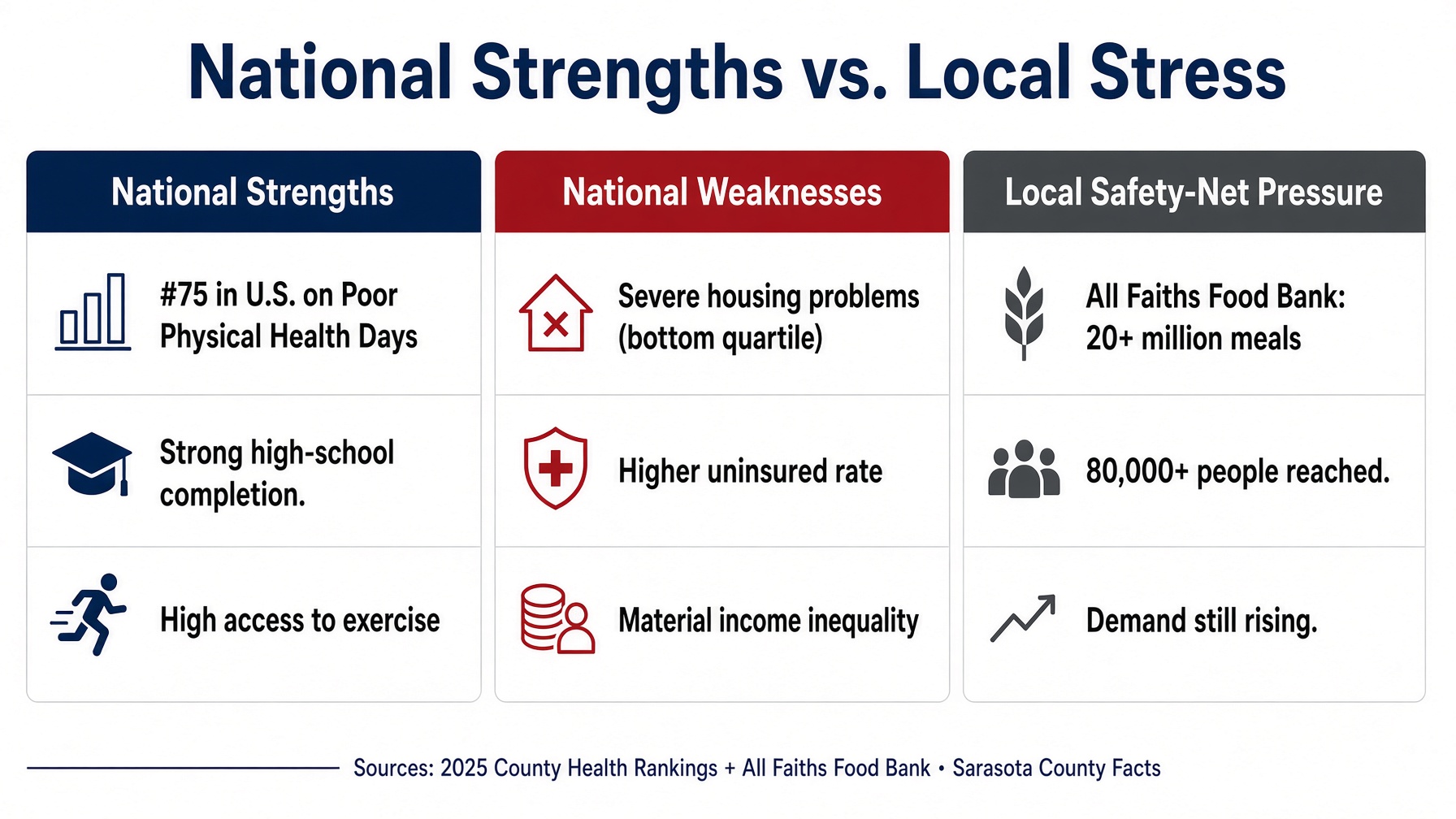
National strengths versus local stress: the same county that ranks among the healthiest in America runs a food bank operation at 20-plus million meals. Sources: 2025 County Health Rankings and All Faiths Food Bank.
The Mechanism of Separation
The pieces fit together with uncomfortable clarity:
- Rapid growth in local government spending and debt raises the overall cost of living.
- Resistance to policies that would expand lower-cost housing supply keeps housing expensive.
- Local wages in the occupations that actually operate the community lag far behind the resulting cost structure.
- Higher reported "median" incomes are inflated by retirees and seasonal residents whose money originates elsewhere.
- Working households respond by doubling up, delaying family formation, relying more heavily on food assistance, or leaving.
- The community that remains becomes progressively more weighted toward those who can pay the higher cost base and progressively less accessible to those who cannot.
This is class separation by policy and arithmetic, not by accident.
A county that becomes unaffordable for the people who staff its hospitals, hotels, restaurants, and construction sites will eventually discover that the amenities prized by higher-income and seasonal residents cannot be sustained without them.
Our Role
Sarasota County Facts has operated as a citizen fiscal watchdog, systematically compiling the spending, debt, public-safety, demographic, health-ranking, and cost-of-living data that make this trajectory visible. The goal is not theatrical confrontation. It is to place the cumulative record in front of residents and decision-makers so that future choices can be made with open eyes rather than comfortable narratives.
The rapid rise in spending and debt is a matter of public record. The resistance to elements of the Live Local Act is a matter of public record. The wage-versus-cost gap for the occupations that keep the community functioning is a matter of public record. The rising volume at the food bank is a matter of public record. These facts do not require embellishment. They require attention.
The Stakes
If current patterns continue, Sarasota risks becoming a place that the American common man and woman who work here — and especially those who wish to raise children here — can no longer afford. The consequences will not be limited to individual hardship. Over time they will appear as staffing shortages, declining service quality, and a community that has priced out the very workforce that makes its lifestyle possible.
Fiscal responsibility, openness to housing supply that matches actual local wages, and deliberate use of public resources to support genuine job creation capable of sustaining a basic living wage are not ideological positions. They are the minimum requirements for avoiding a long-term hollowing-out of the working population.
The data are now compiled. The only remaining question is whether citizens will insist that the arithmetic be taken seriously.
Footnotes & Primary Sources
- Sarasota County FY2026 Adopted Budget documents, Citizens Guide, and Budget Reference Guide (total budget $2,524,495,075; Emergency Services ~$178.6 million; Fire-Rescue assessment ~$77.1 million).
- Sarasota County Sheriff's Office budget trajectory and FY2026 figures (~$221–224 million).
- City of Sarasota, North Port, Venice, and Longboat Key adopted or proposed police/public-safety budget lines (City of Sarasota Police ~$50.6 million; North Port Police ~$39.9 million; Venice Police ~$14.6 million; Longboat Key Police ~$4.6 million + Fire).
- Florida Department of Law Enforcement / FLHealthCHARTS violent crime rates and long-term trend data; Sheriff's public statements on 63% violent-crime reduction since 2009 and ranking among large counties.
- City of Sarasota Police Department 2025 Annual Report (18% overall crime decline).
- Flock/ALPR contract coverage: City of Sarasota (~57 ALPRs, $339,250 two-year contract + Real-Time Operations Center costs); Sheriff's Office earlier 28-unit purchase and subsequent pole installations; Longboat Key annual contract reporting.
- All Faiths Food Bank 2024–2025 reports and public statements (>20 million meals, >80,000 people reached, ~725 monthly distribution points, rising demand).
- 2025 County Health Rankings Data (Select Measure Data and Additional Measure Data tabs) — national Z-scores, Florida ranks, and specific measures including poor physical health days, severe housing problems, uninsured rate, income inequality, children in poverty, and race-stratified outcomes.
- 1000 Friends of Florida / county conservation reporting — approximately 33–34% of land protected; developed land baseline ~30%.
- HUD Fair Market Rents, MIT Living Wage Calculator for Sarasota County, and local wage observations for service, care, and support occupations.
- Point-in-Time homelessness counts for the Manatee-Sarasota Continuum of Care (declining overall totals with noted geographic shifts).
- Public records of county positions regarding the Florida Live Local Act.
- EDR and county population estimates used for per-capita calculations.