
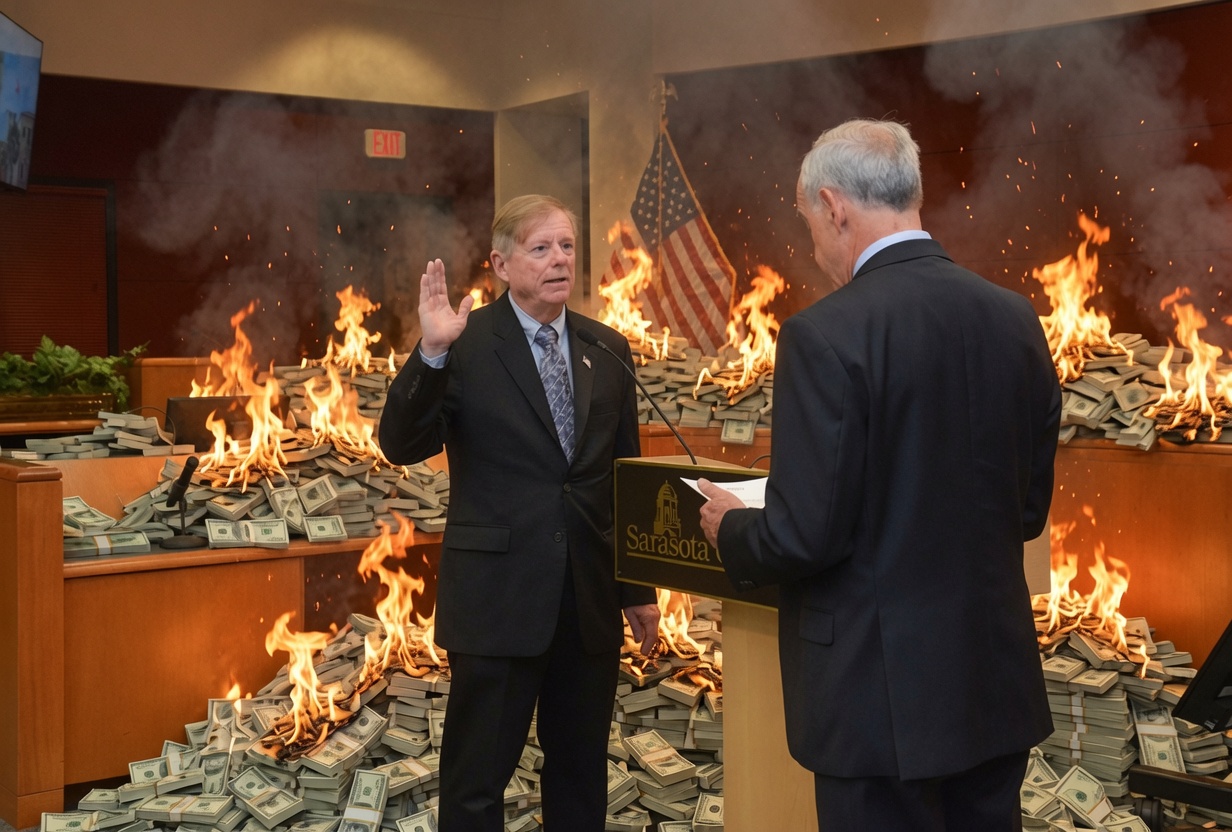
The spending fire: he didn't fight it. He fed it — and he told you so himself.
He Promised to “Fight Inflation and Keep Sarasota Affordable.”
Then he helped pour $876,356,310 of gasoline on the fire.
Mark Smith's own campaign platform promises to “fight inflation and keep Sarasota affordable.” We audited what he actually did with your money — every budget, every bond, every roll-call vote, from the day he was sworn in to today. Every number below comes from the county's own audited books, and every green check links to the source.
His campaign website, in his own words. Hold that sentence. Now watch the match get lit.
On the recordVerified
Fight inflation and keep Sarasota affordable.— Mark Smith's campaign platform — marksmithforsarasota.com, archived June 19, 2025
$876,356,310 in new spending and debt since he was sworn in
Verified $876,356,310 in new spending and debt since he was sworn in.
From the day Mark Smith took his seat in November 2022, the county's combined annual spending and bonded debt grew from $1.45 billion to $2.33 billion — $876,356,310 in new obligations Verified, straight from the county's own audited reports. What that fire costs at your kitchen table:
- $7,189 in new county obligations for every family of four Verified.
- $11,352 in county debt now carried by every family of four the county primarily serves — up 67% in three years Verified.
- Property-tax collections up 23.7% — $64 million more a year — while they called it a “rate cut” Verified.
- A one-income family of four now needs about $87,170 to live here. The average worker earns $60,112 Verified.
Don't take our word for it: independent reporting confirms the county budget jumped roughly 71% since Smith joined the board — from about $1.46 billion to $2.5 billion Verified. That's not fighting inflation. That's feeding it — with your money as the fuel.
He promised to fight the fire. The audited books show him feeding it — $7,189 a family.
713 yes votes on money. 3 no's.
Verified 713 yes votes on money. 3 no's. $2.99 billion approved. $295,732,000 in new debt.
On budgets, bonds, taxes, and rate increases, Mark Smith's roll-call record is 713 YES, 3 NO Verified. His yes votes authorized $2.99 billion in county spending Verified and $295,732,000 in brand-new county debt Verified — through the biggest fiscal expansion in the county's modern record. Can, after can, after can — 713 times.
He told you the money wasn't there. Out loud. Then he voted yes.
Verified He said it on the record — then voted yes anyway.
August 2025, county budget workshop. Mark Smith, verbatim:
On the recordVerified
We're spending money that we are not going to have. And we're running out of track and not slowing down.— Commissioner Mark Smith, August 2025 county budget workshop — Suncoast Searchlight
Weeks later, the largest budget in the county's modern record — $2.52 billion — came to a vote. Smith voted yes. Twice. The only no in the room was Commissioner Tom Knight, the former three-term sheriff, who said the board had been allowed to “spend like drunken sailors” and called the county's course “a path to destruction” Verified.
The county's own projections now show deficits of $31.6 million, $40.8 million, and $39.2 million in the next three years Verified. He wasn't fooled. He wasn't misled. He saw the fire, described the fire — and voted to keep pouring. Knowing better isn't a defense. It's the charge.
He stood alone to keep paying a $7.5 million grant
Verified When the board clawed back a $7.5M grant to a construction-industry nonprofit that raised $0 on its own — Smith stood alone to keep paying it.
The county awarded $7.5 million in federal hurricane-recovery money to the Building Industry Institute — a construction-industry nonprofit whose own IRS filing showed zero dollars raised in private donations, which never secured a property, and whose separate $350,000 state appropriation had been redirected from a hurricane-shelter project Verified. When the board voted 3–1 in April 2025 to claw the money back, the one vote to keep paying was Mark Smith Verified.
Hurricane money. A nonprofit with no track record and no building. And he was the last man holding the gas can.
$186,500 in development-industry money backing Smith
Verified $186,500 in development-industry money — including more direct developer money than Neunder.
Name-verified development-industry contributions to Smith's committee and the shared PAC backing the incumbent slate total $186,500 — with $16,000 given directly to Smith, more than District 4's Joe Neunder took directly ($12,300) Verified. Culverhouse, Benderson, Neal, Schroeder-Manatee, Hi Hat Ranch — the same names, the same shared PAC, the same slate. And the Building Industry Institute he stood alone to keep funding? A construction-industry nonprofit. The pattern isn't hidden. It's filed with the state.
Our standard doesn't bend for anyone, so here's the other side of the ledger: Smith broke from the board on land use 28 times, including no votes on the 6,576-home 3H Ranch and the January 2025 mega-rezones Verified. On development, his record shows real dissent — though not always: he voted yes to rezone the Sarasota Square Mall property for hundreds of market-rate apartments with no affordable housing, saying his hands were tied Verified.
But this seat isn't up over rezones. It's up over money — and on money, the record is 713 yes, 3 no, a confession on tape, and a lone stand for a $7.5 million grant to the industry funding his slate.
The promise vs. the audited record
He promised to fight inflation and keep Sarasota affordable. The audited record shows $876,356,310 in new obligations, a 23.7% property-tax increase sold as a cut, $11,352 in county debt on every family of four — and his own voice on tape saying the money isn't there, followed by his own yes vote.
In 2022, Mark Smith won this seat by 373 votes out of nearly 38,000 cast Verified. District 2 is decided in the Republican primary on August 18 — no Democrat qualified, so the primary is the decision. The record is now in front of you — and what you do with it is yours.
A candidate questionnaire has gone to every candidate in this race, each with seven days to respond; findings will be published to the same standard.