

Some People Are Calling Amendment 3 “the End of Property Taxes.” It Is Not.Here Is What It Means for Your Home, Your Rent, and Other Property Owners in Sarasota County.
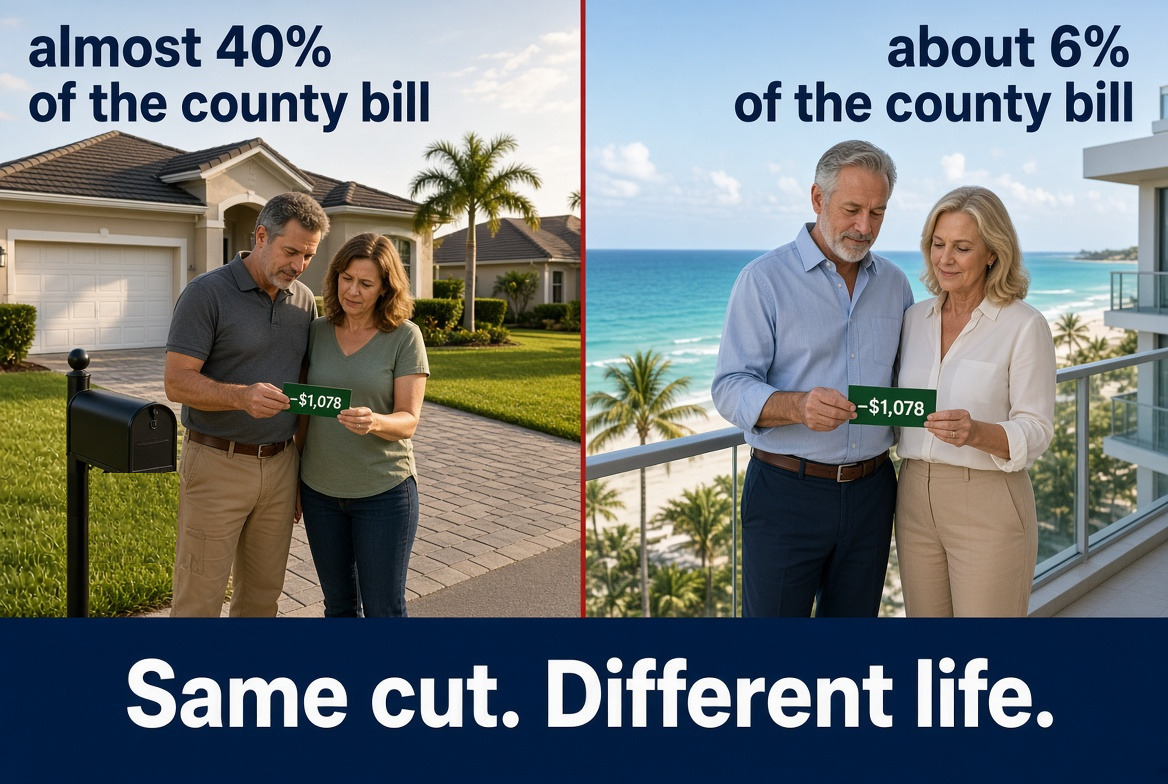
On November 3, you will be asked to vote yes or no on Amendment 3. If it passes, people who own the home they live in will get a much bigger reduction in their property taxes. In Sarasota County, that reduction is worth about $1,078 a year on the county part of the bill. It is the same $1,078 whether your home is worth $280,000 or $10 million. That means it cuts the whole property-tax bill by almost 40% for a $280,000 home and by less than 1% for a $10 million beachfront estate.
That figure is not an average, and it does not depend on the price of a typical home. It comes from simple math. The amendment shields an extra $200,000 of a home’s value from county taxes, and the county’s tax rate on that value is about $5.39 for every $1,000, so 200 times $5.39 equals $1,078. If you are a renter, you will not receive any of this reduction, because landlords do not get the $250,000 exemption on the homes and apartments they rent out. The smaller benefit landlords do get is explained below, and nothing requires them to pass any of it on to you.
There is a second half to the story. If the amendment passes, Sarasota County’s government will collect about $87 million less each year once the break is fully in place. The five county commissioners will then have to decide whether to make up that money by raising the tax rate, adding fees, asking you to approve a sales tax, cutting services, or simply spending less. This guide explains both halves.
You have probably heard Amendment 3 described as “the end of property taxes.” Some supporters have used that phrase, and some headlines have repeated it. It is not accurate. Amendment 3 is one specific, permanent tax break for people who own the home they live in. It also adds new rules that make it harder for your city and county to collect more money from you without voting to do so in public. This guide does not tell you how to vote. It explains what the amendment does, one kind of household at a time, using Sarasota County’s own numbers. It assumes you know nothing about property taxes. Most people do not, and that is fine.
Part 1: What you are actually voting on
Before we go further, there are three words you need to know, because the whole amendment is built on them.
A “homestead” is the home you own and live in as your main residence. You register it once with the Sarasota County Property Appraiser.8 A rental, a vacation home, or a business property cannot be a homestead.
A “mill” is the unit local governments use to set the tax rate. One mill means you pay one dollar of tax for every $1,000 of your home’s taxable value. Your taxable value is not what your house would sell for. It is the value the Property Appraiser has on file for your home, called the assessed value, minus your exemptions. For most long-time owners it is far below the sale price.
An “exemption” is a slice of your home’s value that the tax never touches. Today, a homesteaded house in Sarasota County has about $50,000 of its value shielded from most property taxes.11 Amendment 3 would make that shield five times bigger, raising it to $250,000.
It is just as important to know what the amendment does not do. It does not repeal property taxes. It does not change school taxes. And it does not automatically lower anyone’s rent.
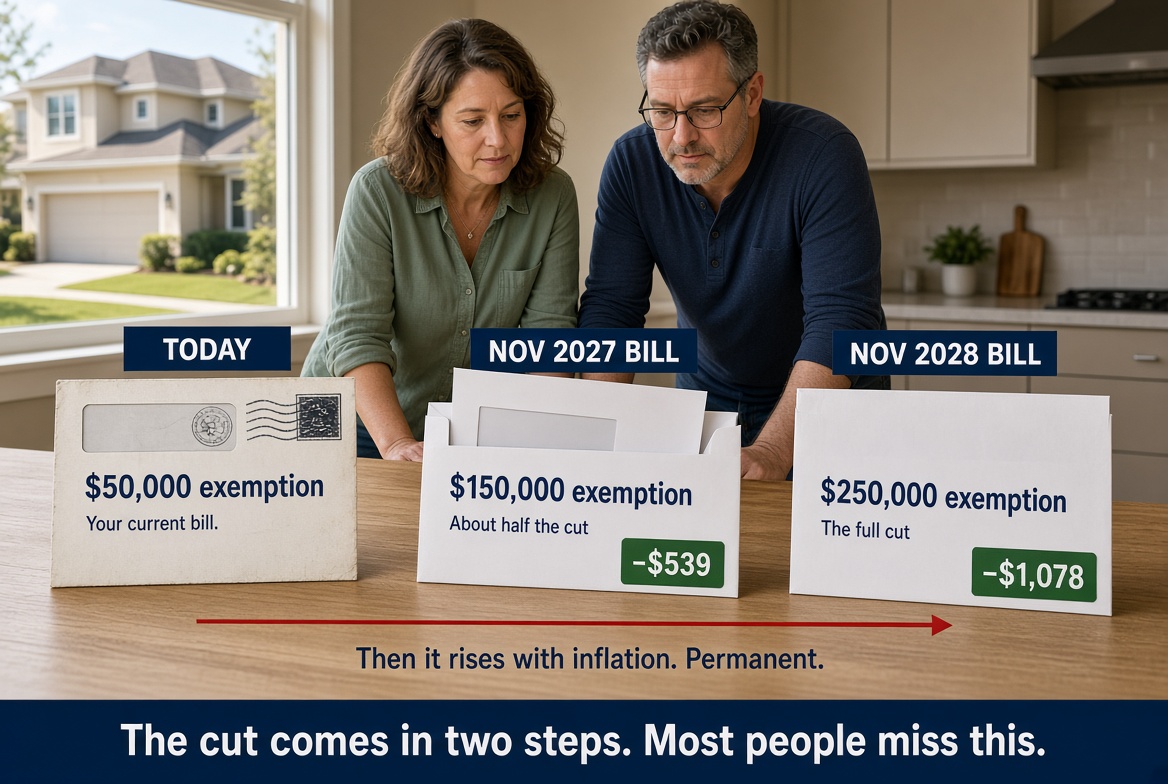
- The break gets much bigger, and then it keeps growingThe exemption rises to $150,000 in 2027 and to $250,000 in 2028. After that, it rises with inflation every year. It does not expire.1
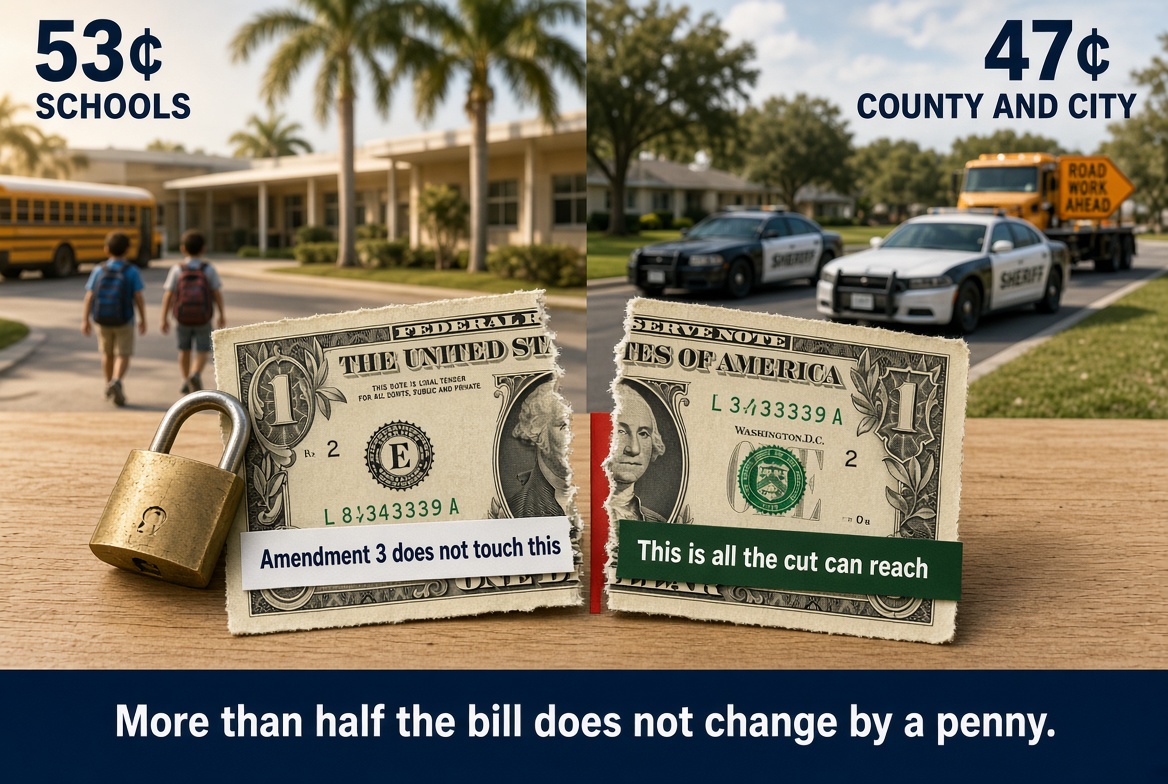
- School taxes are left outSchool taxes keep today’s smaller exemption. Because schools take about 53 cents of every property-tax dollar, more than half of a typical bill does not change at all.14
- Save Our Homes staysSave Our Homes is the existing rule that limits how fast a homestead’s taxable value can rise, to 3% a year. The amendment does not change it. A claim going around online says homesteads will be reset to market value if this passes. The sentence people point to has been in the constitution since Save Our Homes passed in 1992. The amendment does not change it and adds no new reset.120
- Newcomers wait five yearsIf you were not living in Florida as your permanent home on December 31, 2026, you get today’s $50,000 exemption when you buy, and the full break starting in your fifth year as a homeowner here. A nurse who moves here from Ohio in 2027 keeps paying today’s bill, with no new cut, while a neighbor in an identical house saves $1,078. A Sarasota renter who buys a home in 2027 does not wait, because she was already living here.1
- Landlords and second-home owners get no exemption, but they get a tighter capA rental house, an apartment building, or a second home is not a homestead, so it gets none of the $250,000 exemption. What it gets is a lower limit on how fast its taxable value can rise: 5% a year starting in 2027, instead of 10% today. Nothing in the law requires the owner to pass any of that on to a tenant. The box below explains this in more detail.1
- Renters get a “may,” not a “shall”The text says lawmakers “may” provide relief for renters. In a law, “may” means they are allowed to, and “shall” means they have to. This one says “may.” It does not say how, when, or with what money.1
The $250,000 exemption goes only to a person who owns a home and lives in it as his or her permanent residence. That is the wording of the amendment itself. A house that is rented out, a duplex the owner does not live in, and an apartment building are not the owner’s residence, so none of them qualify. The amendment also says that no person or family may claim more than one exemption, and that no residential unit may carry more than one. A landlord who owns five rental houses gets one exemption, on the home the landlord lives in, and none on the five rentals.1
What landlords and apartment owners do get is a change to a different rule. Today, the taxable value of a rental property can rise by up to 10% a year for all taxes except school taxes. Starting January 1, 2027, that limit drops to 5% a year. It applies to small rentals of nine units or fewer and to large apartment complexes alike. This does not lower anyone’s bill this year. It only slows how fast the bill can grow in future years, and only in years when the property’s value would have risen by more than 5%.1
Put those two facts together, and here is what it means if you rent. There is no $1,078 cut on your building for your landlord to share with you. If the county raises its tax rate to make up the money it loses on homesteads, your landlord’s bill goes up, not down, and that cost can reach you through your rent. The amendment does say the Legislature “may” provide tax relief to renters who are permanent residents, but it does not create a program, set an amount, or provide any money.1
There is one thing the amendment does do for renters who want to buy. The five-year wait for the full exemption applies only to people who were not living in Florida on December 31, 2026. If you are renting in Sarasota today and you buy a home here in 2027 or later, you get the full exemption right away.1
The cut comes in two steps, and this is the part most people miss
If the amendment passes, you do not get the full $1,078 right away. The exemption grows in two steps. You see about half of the cut on the tax bill that arrives in November 2027, and you see the full cut on the bill that arrives in November 2028.
| When | Exemption on non-school taxes | What you see |
|---|---|---|
| Today | $50,000 | Your current bill |
| January 1, 2027 | $150,000 | About half the cut, on the bill mailed November 2027 |
| January 1, 2028 | $250,000 | The full cut, on the bill mailed November 2028 |
| 2029 and after | Rises with inflation | The cut grows a little each year. It is permanent. |
More than half of a typical bill, the school half, does not change by a single penny. The amendment only touches the other 47 cents.
Source: Sarasota County FY2026 Budget Reference Guide [14].
There is one more clause worth reading closely, because it is where the fine print lives. The amendment says your city and county may use property taxes “only” for a list of purposes. The list is police, fire, and ambulances; schools; roads, bridges, and stormwater; flood control and other natural-resource projects; paying off bonds; and employee pensions. That sounds like a hard limit on what local government can do with your money. But the same list includes an item, labeled (g), that also allows property taxes to pay for “the operations and administration of county officers and commissioners,” plus anything else the commission votes to approve, unless a future state law bans it. In plain terms, the commission can still spend property tax on a wide range of things. What is new is that the state Legislature now has the power to say no, item by item.1
The text also tells the Legislature to write a uniform process so that a city or county could later raise its own homestead exemption all the way up to a home’s full value. That would be a future choice for local officials to make in public. It is not an automatic end to property taxes.1
Part 2: How this got on your ballot
In 2026, Governor Ron DeSantis called the Legislature into a special session, and that session put this amendment on your ballot. To understand why, you need to know about the problem he pointed to. All over Florida, cities and counties saw the money they collect from property taxes surge. That did not happen because anyone voted to raise taxes. It happened because a wave of new residents pushed home values through the roof, and the tax system let local governments collect on those higher values without ever casting a vote to raise your taxes.23
Here is how that works. Your property-tax bill is the tax rate multiplied by your home’s taxable value. When home values jump 17% in a single year, a county commissioner can hold the rate flat, or even lower it a hair, and still collect far more money than the year before. Every commissioner can honestly say, “I never raised your taxes.” Every homeowner watches the bill go up anyway. Sarasota County is a clear example of this.
Every year, the commission could truthfully say it never raised the tax rate, and every homeowner could truthfully say the bill went up anyway. When the value of your house jumps 17% one year, then 14%, then 9%, a “flat” rate still collects a lot more money. County property-tax collections rose 30.9% in just three years while the rate slightly fell. That automatic growth is what Amendment 3 is aimed at.
Source: Sarasota County FY2026 Budget Reference Guide [14][15].
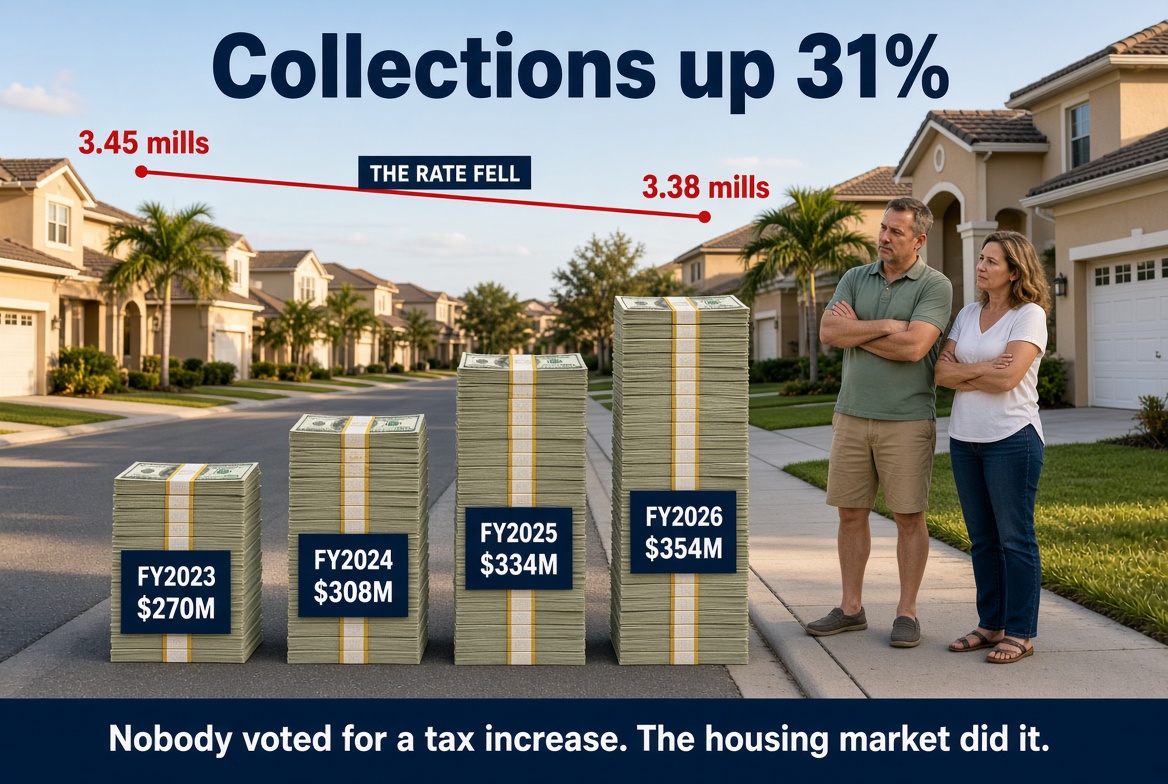
Over three years, the county’s tax rate went down slightly, and the money the county collected went up 31%. Nobody had to vote for a tax increase. The rising housing market did it for them.
The county spent that extra money. In fiscal year 2023, the budget year before the current commission majority took office, the county’s total budget was about $1.46 billion. The new majority’s first budget vote raised it 38.5% in a single year. The adopted budget for fiscal year 2026 is $2.52 billion. That is a 73% increase across three budgets. The county did not add 73% more people in three years. On those same budgets, both total spending and total debt crossed $1 billion for the first time since the county was created in 1921.23
This was not only a Sarasota problem. The state’s own economists estimate that the amendment will take $4.95 billion a year out of local government budgets across Florida in its first year, and $8.78 billion a year once it is fully phased in.5 You can read that number the other way around. It is a measure of how much extra money rising home values had been feeding into city and county budgets across the state.
Now compare the state government to the local governments. The State of Florida runs a balanced budget, holds billions of dollars in reserve, and has no income tax. The local governments, meanwhile, rode the surge in property values into a spending boom. The Governor’s argument is about checks and balances. If the state can grow within its means, so can a county. And if a county wants to keep spending faster than its population grows, it should have to ask its residents first.
That is the real heart of Amendment 3, and it is easy to miss under the “no property tax” headline. It moves a decision back to you. It takes $200,000 of every homesteaded home’s value permanently off the tax rolls, which shrinks the automatic growth in the county’s tax collections. By shrinking the tax base, meaning the total taxable value of all the property in the county, it forces the choice into the open. If a local government still wants that money, it has to raise a visible tax rate, put a sales tax on the ballot, or defend its spending line by line in public. It is the same idea behind the Live Local Act, the 2023 state law, also championed by the Governor, that gives landlords a property-tax break for keeping rents affordable. Both are aimed at working families and people born and raised here who have been priced out by home prices, property taxes, and insurance.10
Many city and county officials are alarmed by this amendment, and the reason tells you who it is really aimed at. The amendment does not ban local governments from spending. It makes them ask permission in daylight. If they want to grow spending and debt beyond what the smaller tax base can cover, they now have to face the voters or defend the budget out loud. For a government that got used to a tax bill that quietly grew itself every year, that is a hard adjustment. For the family paying the bill, that is the whole point. Whether you think that trade is worth it is exactly what your vote decides.
Part 3: What it would cost Sarasota County, in dollars
In August, the county’s own administrator told the commission what the amendment would cost the county. The county would collect $46.9 million less in fiscal year 2028 and $87.1 million less in fiscal year 2029, once the exemption is fully phased in.6 The county’s fiscal year starts on October 1, so fiscal year 2028 is the budget paid for by the tax bills you get in November 2027, when the exemption is $150,000, and fiscal year 2029 is paid for by the November 2028 bills, when it reaches $250,000. That is why the first year’s loss is about half of the second. To help the commissioners picture $87 million, he translated it into a tax rate. Replacing that money with a rate increase would take about 0.6214 mills. Today’s main county rate is 3.3842 mills. So making up the money that way would mean roughly an 18% jump in the county’s main tax rate, charged on the smaller tax base that is left.614
The cities lose money on top of what the county loses. The City of Sarasota’s own FAQ estimates its loss at about $5.5 million to $5.6 million a year.17 North Port, Venice, and Longboat Key each lose money on their own tax lines too.
Here is the number that explains who this reaches. Of the county’s 304,930 properties, only 105,884 are homesteads. That is about one in three.7 The other two-thirds are rentals, second homes, businesses, and vacant land. None of them get the new exemption. Whatever the commission does to make up the lost money falls on those owners first, and on renters through their landlords.
Part 4: What happens to your bill, house by house
Now let us look at real bills. The tables below show what happens to different Sarasota County households, using the county’s own 2026 tax rates for the unincorporated area, which means outside the city limits.1314 Each bill is the whole property-tax bill, including the school line that does not change, but before the flat fees for fire, trash, and stormwater. The last column shows the extra you would pay if the county chose to make up its lost money by raising the tax rate the amount its own administrator said it would take.6 Notice who pays the extra.
| Household | Today | 2027 ($150k) | 2028 ($250k) | Saving / yr | Share of bill | Extra if the county raises its rate to make up the loss (+0.6214 mills) |
|---|---|---|---|---|---|---|
| Renter (landlord’s ~$300k unit, no homestead) | none* | — | — | $0 | — | +$186 to landlord† |
| Renter in an income-restricted (Live Local) apartment | none* | — | — | $0 | — | — |
| Working-class homeowner ($280,000) | $2,790 | $2,251 | $1,712 | −$1,078 | 38.6% | +$19 |
| Median homesteader ($373,100) | $3,858 | $3,319 | $2,780 | −$1,078 | 27.9% | +$76 |
| Upper-income homesteader ($1,500,000) | $16,784 | $16,245 | $15,706 | −$1,078 | 6.4% | +$777 |
| Snowbird / second home ($800,000) | $9,176 | $9,176 | $9,176 | $0 | 0% | +$497 |
| New Floridian arriving 2027 ($373,100) | $3,858 | $3,858 | $3,858 | $0 | 0% | +$201 |
* Renters get no property-tax bill of their own; the landlord pays it. † About $16 a month if the landlord passes every dollar of it into your rent.
More Sarasota households: find the one closest to yours
The first table covers the classic cases. But Sarasota is also a county of mobile home parks, barrier-island condos, and long-time owners whose taxable values have been capped for decades. Here are more households, run through the same math.1322 These bills are for homes outside the city limits. If you live inside a city or town, add the city line from the table after this one.
| Household | Today | 2028 ($250k) | Saving / yr | Share of bill | Extra if the county raises its rate to make up the loss (+0.6214 mills) |
|---|---|---|---|---|---|
| Venice manufactured home on land you own ($180,000, homesteaded) | $1,643 | $942 | −$701* | 42.7% | $0 |
| Venice mobile home on a rented lot (you own the home, the park owns the land) | decal fee only† | — | $0 | — | via lot rent† |
| Long-time homesteader: house worth $373,100, Save Our Homes assessed value $200,000 (example) | $1,873 | $1,064 | −$809* | 43.2% | $0 |
| Longboat Key condo, year-round resident ($1,500,000, homesteaded) | $16,784 | $15,706 | −$1,078‡ | 6.4% | +$777 |
| Longboat Key condo, snowbird ($1,500,000, no homestead) | $17,205 | $17,205 | $0 | 0% | +$932 |
| Downtown Sarasota condo ($3,000,000, homesteaded) | $33,989 | $32,911 | −$1,078‡ | 3.2% | +$1,709 |
| Beachfront estate, Siesta or Casey Key ($10,000,000, homesteaded) | $114,279 | $113,201 | −$1,078 | 0.9% | +$6,059 |
| Beachfront estate as a second home ($10,000,000, no homestead) | $114,700 | $114,700 | $0 | 0% | +$6,214 |
| Tourist in a hotel or short-term rental | none | — | $0 | — | sales surtax only |
* The saving is smaller than $1,078 only because it wipes out the whole non-school county bill; there is nothing left to cut. † A mobile home on a rented lot pays a yearly decal fee, not a property-tax bill; a county rate hike lands on the park owner and may reach your lot rent. ‡ Before the city or town line; add $392 on Longboat Key or $655 in the City of Sarasota from the next table.
Every number in these tables comes from the same simple math. The county tax lines that the amendment can touch add up to about 5.39 mills in this model. That means $5.39 of tax for every $1,000 of taxable value. The new exemption shields an extra $200,000 of value. So the saving is 200 times $5.39, which comes to $1,078.
Now do the same for your own home. Find the line called “assessed value” on your TRIM notice, which is the letter the Property Appraiser mails you every August. Subtract $250,000 from it. If the answer is zero or less, your county non-school taxes disappear in 2028, and your saving is whatever those lines cost you today. If the answer is more than zero, your saving is about $1,078 if you live outside a city, and more if you live inside one. If you have owned your home for a long time, your assessed value is probably far below what the house would sell for today. That is Save Our Homes doing its job. It is also why the long-time owner in the table saves $809 instead of $1,078: there was less bill left to cut.
If you live inside a city, you save more, because the city’s own tax line gets the break too. Add these amounts to the county cut above.14
| If you live inside | Extra saving on the city line (2028) | Total with the county line |
|---|---|---|
| North Port | $753 | $1,831 |
| Venice | $769 | $1,847 |
| City of Sarasota | $655 | $1,733 |
| Longboat Key (Sarasota County side) | $392 | $1,470 |
The cut is a flat dollar amount, not a percentage. That is what makes it a working-class tax cut for the people who own their homes. The modest house gets almost 40% off its whole property-tax bill, the $1.5 million house gets about 6% off, and the $10 million estate gets less than 1% off. The smallest home saves fewer dollars only because its whole non-school bill was less than $1,078 to begin with.
Source: Sarasota Fiscal Truth model on Sarasota County FY2026 millage [13][14]; $180,000, $3M and $10M rows extend the same model.
Each bar is the whole property-tax bill for a home outside the city limits, school line included, before the flat fees for fire, trash, and stormwater. If you live inside a city, you save even more. Once the exemption reaches $250,000, a North Port homeowner saves about $1,831 a year when you add the city’s own tax line to the county cut.
Source: Sarasota Fiscal Truth household model [13]; Sarasota County FY2026 millage [14].
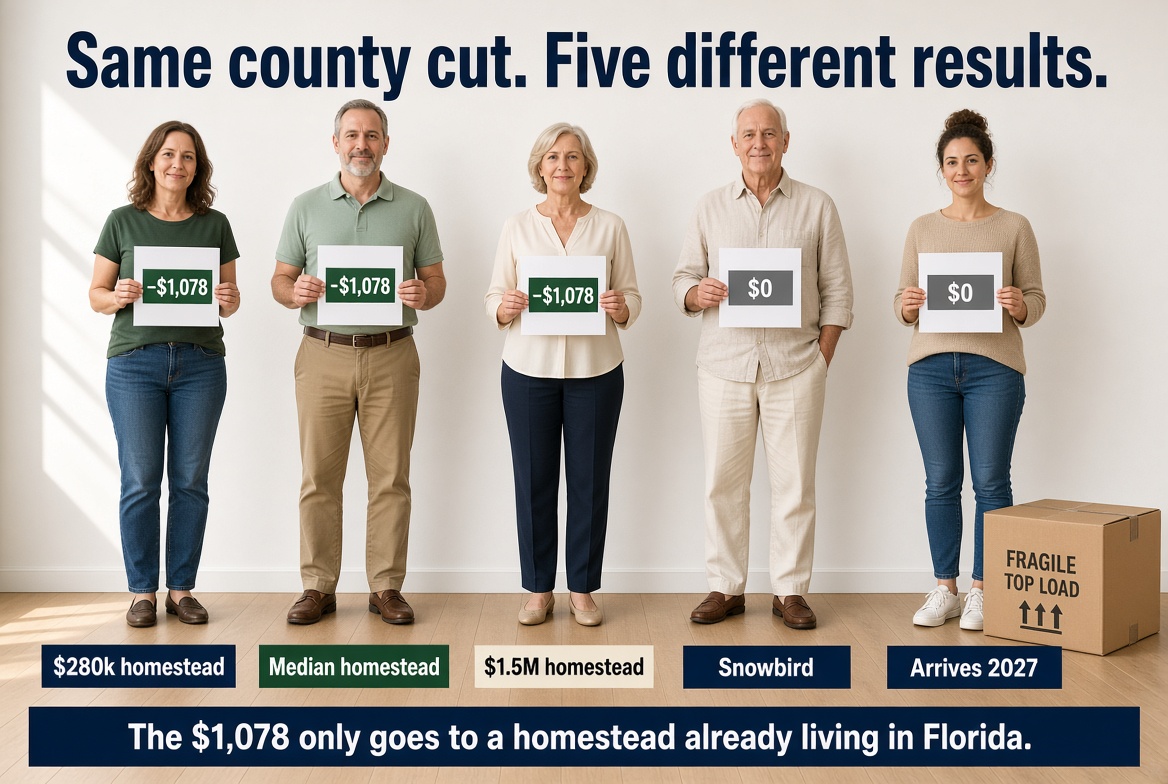
A snowbird owns a home here but lives somewhere else for most of the year. A snowbird’s Sarasota home is not a homestead, so a snowbird gets no cut. But the snowbird pays property tax on every dollar of the home’s value, and pays every dollar of any rate increase the county passes to make up the lost money. The $800,000 snowbird in the table would pay about $497 more a year, and the $1.5 million Longboat Key snowbird about $932 more. The snowbird does get one thing from the amendment: the taxable value of the home can rise no more than 5% a year instead of 10%.1
A tourist rents a room and pays no property tax at all. The tourist pays sales tax and the county’s tourist tax on the room. State law restricts that tourist-tax money to tourism uses, like beaches and promotion, so it cannot legally be used to make up the county’s lost property-tax money.21 The only way a visitor helps pay is if the county asks you to approve a sales surtax. A sales surtax reaches what tourists buy, but it also falls hardest on the county’s lowest-income families.12
Part 5: Who comes out ahead, who is left out, and what each side says
So who comes out ahead? The honest answer has two halves, and they point in different directions.
The tax cut itself favors the modest house. Because the exemption is a flat $250,000 for every homestead, the ranch house in North Port and the estate on Casey Key save the exact same $1,078 on the county lines of the bill. For the ranch, that is almost 40% of the whole property-tax bill. For the estate, it is less than 1%. The retiree on a fixed income in a paid-off 1990s ranch, or in a manufactured home on a lot she owns, is the biggest winner in the county in percentage terms.
The people left out of that half are not the wealthy. They are renters, who get only a “may,” and newcomers, who wait five years. The second half of the story is the $87.1 million a year the county would stop collecting. That is where a working family can still lose, if the county makes up the money in the wrong way. The county does not simply absorb that loss. It sends the cost to someone.
- It is a permanent cut to the homestead bill that grows with inflation, not a one-time rebate.
- A flat dollar cut is worth the most to the smallest house. For a $280,000 home, it is almost 40% of the whole property-tax bill.
- It ends the quiet growth in tax collections. To get the money back, a commission must raise a visible rate or ask the voters.
- Landlords get a 5% cap on how fast their taxable value can rise, which supporters say eases pressure on rents over time.
- Two of every three properties in the county are not homesteads. Renters and newcomers get nothing directly.
- The $87.1 million does not vanish. It moves to fees, a sales surtax, service cuts, or the owners who have no homestead.
- Cities lose money on top of the county. The City of Sarasota alone puts its loss at about $5.5 million a year.
- The “core services” clause and the renter “may” leave big questions for the Legislature to answer later.
Part 6: What the commissioners can do about the missing $87 million
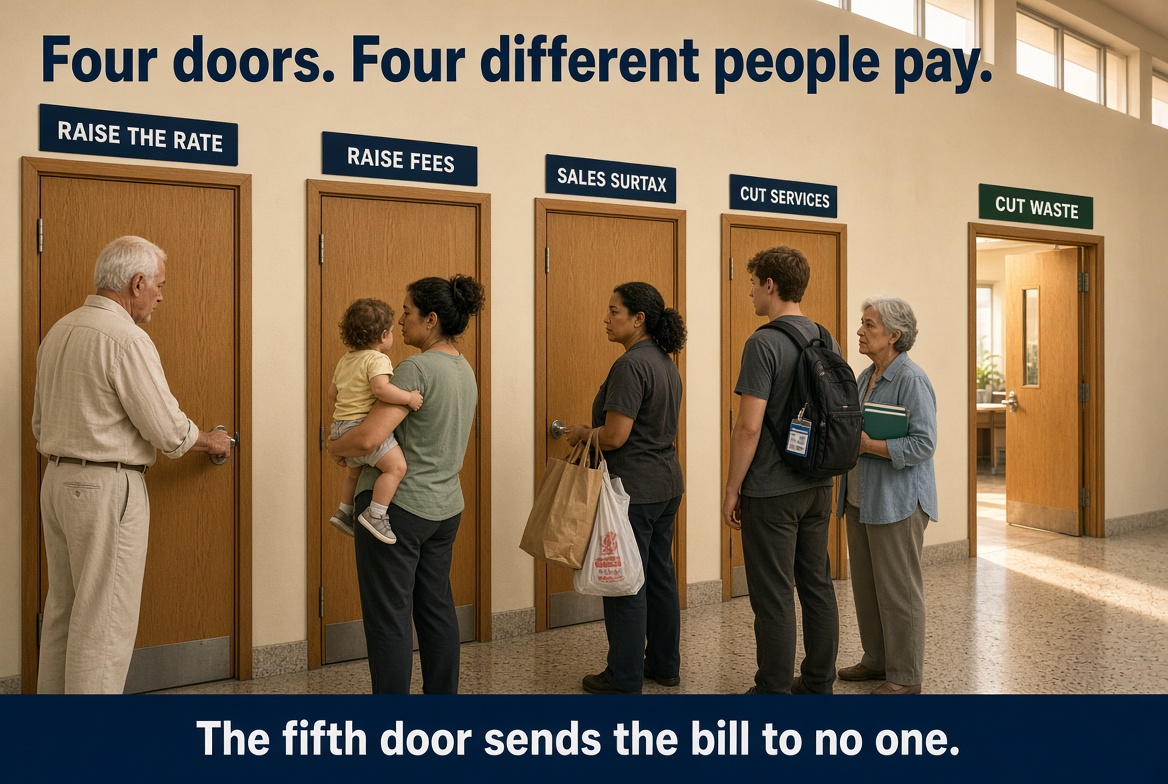
This is the decision your vote hands to the five members of the Sarasota County Commission. If the amendment passes, they have four ways to get the money back, and each one sends the bill to a different group of people. There is also a fifth way, which sends the bill to no one. One term you will see below: a “sales surtax” is an extra half-penny or penny added to the sales tax on what you buy in the county. Only voters can approve one.
The $280,000 homeowner pays about $19 more a year, the $1.5 million home about $777, the $10 million beachfront estate about $6,059, and the $800,000 snowbird about $497 with no cut to offset it. This route lands mostly on non-residents, investors, and the biggest homes.
Fire, stormwater, and trash fees are a flat amount per house, so the $280,000 home pays the same as the $1.5 million home. Because a fee is not a tax rate, it never shows up as a tax increase. This is the quiet route, and it hits small homes hardest.
Sales tax takes 7.4% of income from Florida’s poorest fifth of families and just 1% from the top 1%. This route needs a public vote, and it will be sold to you as “just a penny.”
The administrator’s own sample list of possible cuts included libraries, parks, the free Siesta Key trolley, lifeguards, transit, and veterans services. These are used most by people who do not own $1.5 million homes.
The three red boxes are the routes that fall hardest on working families and renters. The fifth option, the one this site argues for, is not on this chart: cut the waste, not the services.
Source: County Administrator’s Aug. 21, 2026 budget workshop [6]; ITEP “Who Pays?” [12].
One shift happens automatically, with no vote at all. The county still has to pay off debt that voters approved in the past, such as the Legacy Trail and the environmentally sensitive lands program, no matter what. When that fixed payment is spread over a smaller tax base, the rate that covers it “has to go up a little,” as the administrator put it. That increase lands on every owner without a homestead: landlords, businesses, and snowbirds. Through rent, some of it reaches tenants too.6
The fifth choice: spend less, without cutting the services you use
The county has one option that does not appear on the “who pays” chart, because it does not send the bill to anyone. It can stop spending the money in the first place. Sarasota Fiscal Truth has identified $49.85 million to $140.5 million a year in savings from overhead, outside consultants, and padded construction plans. None of those savings touch the services families use. That range alone is enough to cover the whole $87.1 million gap.16 The county does not have to choose between the tax break and the library. It can close the gap by running leaner.
We are not telling you how to vote on Amendment 3. We are telling you what we think the county should do if it passes. The smart move is a local, Sarasota version of the belt-tightening the country has been talking about: a DOGE-type effort that uses today’s technology to streamline the county’s administrative costs and paperwork instead of reaching back into your pocket. Automate the back office. Cut the consultant contracts. Digitize the permitting process. Trim the overhead that grew during the boom years. If the county does that, the working family keeps its tax cut, the renter keeps the bus and the library, and nobody has to vote for a “penny” sales tax. That is what a check and balance is supposed to produce: not a smaller set of services, but a smarter government.
Part 7: Will a tax cut push house prices up?
You will hear this argued both ways. Supporters point to California after Proposition 13 passed in 1978 and say property values rose after that tax cut.19 Economists who studied Proposition 13 found a more mixed picture. A permanent cut in the yearly cost of owning a home gets partly built into the price of the house, and it also makes long-time owners less likely to move.18
Here is the simple version of the math. A buyer who will save $1,078 a year, every year, will pay something extra for that. At a 5% rate of return, $1,078 a year is worth about $21,560 up front. Compared to a $373,100 house, that is real but not huge, about 6%. And it only applies to houses that get the break. A buyer who arrives from another state after 2026 waits five years, which blunts the effect further. So the answer is: a little, for the homes that qualify, but not a boom.
Part 8: How to keep watch on your local government after November
Nothing in this amendment runs itself. Every dollar of it, both the cut you get and the way the county fills the gap, is decided in public, on a calendar, by people you elect. Here is where to be and what to ask.
- By March 1, 2027
If you bought your home in 2026, file for your homestead exemption with the Property Appraiser by this date. If you do not file, you do not get the exemption or the saving.
- July 2027 & 2028
Watch for the “rolled-back rate.” That is the tax rate that would collect the same amount of money as the year before. Under state law, any rate above it counts as a tax increase, no matter what it is called.
- August 2027 & 2028
Your TRIM notice arrives in the mail. Read the bottom half, because that is where the fire, stormwater, and trash fees are listed.
- September budget hearings
The law requires two public hearings on the county budget. This is the room where the commission decides whether to cut the trolley or cut the consultants. Show up.
- 2027 legislative session
The Legislature writes the rules for the “core services” clause. Those rules will decide what the clause actually means for your county.
- Any sales surtax vote
A sales surtax is the route that falls hardest on low-income families. Before you vote yes on one, ask what spending it replaces.
Source: Florida TRIM law; Sarasota County Property Appraiser [7][8][9].
At the September budget hearings, ask the commission one plain question: “What is the dollar gap, and what is the ordered list of what gets cut first?” If the honest answer starts with consultants and overhead, working families win twice. If it starts with the trolley and the library, you will know the commission skipped the easy savings on purpose.
Questions people are actually asking
- Does Amendment 3 end property taxes?
- No, it does not. It raises the homestead exemption on non-school property taxes to $250,000 by 2028. You will still get a tax bill. If you own and live in your home, that bill will be smaller.
- Does it change school taxes?
- No. School taxes keep today’s exemption. Schools take about 53 cents of every property-tax dollar in Sarasota County, so more than half of your bill does not change at all.
- When does it start?
- If it passes on November 3, 2026, it takes effect on January 1, 2027. The exemption is $150,000 for 2027 and $250,000 for 2028. You see about half of the cut on the tax bill that arrives in November 2027, and the full cut on the bill that arrives in November 2028.
- Do I have to do anything to get it?
- If you already have a homestead exemption, you do not have to do anything. The new exemption applies automatically. If you bought your home in 2026, you need to file for a homestead exemption with the Property Appraiser by March 1, 2027. If you do not file, you do not get the exemption.
- I have lived here for decades, and Save Our Homes already keeps my bill low. What happens to me?
- Save Our Homes stays exactly as it is. Your assessed value keeps its 3% yearly cap. The new exemption comes off that capped value. If your assessed value is under $250,000, your county non-school taxes drop to zero in 2028. Your saving in dollars may be less than $1,078, but only because your bill was already lower than a new buyer’s.
- I rent. What do I get?
- You get nothing directly. The exemption goes only to an owner who lives in the home, so your landlord does not get it on the property you rent, and there is no cut for the landlord to pass along. Your landlord does get a tighter 5% cap on how fast the taxable value of the building can rise, but nothing in the amendment requires any of that to reach your rent. The amendment says lawmakers “may” help renters in the future. It sets aside no money to do so. One thing does help you: if you are living in Florida on December 31, 2026, and you buy a home later, you get the full exemption right away. The five-year wait applies only to people who move here after that date.
- I own rental houses or an apartment building. Do I get the $250,000 exemption on them?
- No. The exemption goes only to a property that is the owner’s permanent residence, and the amendment allows only one exemption per person or family and one per residential unit. Rental houses, duplexes you do not live in, and apartment buildings get no exemption at all. What they get is a lower cap on yearly increases in taxable value: 5% starting in 2027 instead of 10% today, for all taxes except school taxes. That slows future increases. It does not lower this year’s bill. If you live in one unit of a building you own, the part you live in can still be your homestead, just as it can today.
- I live in a mobile home park in Venice. Does this help me?
- It depends on who owns the land under your home. If you own the lot, the home is taxed as real property and you can claim a homestead exemption on it, so you get the cut. If you rent the lot, you pay a yearly decal fee instead of property tax on the home, and the amendment does not change that. The park owner’s land is not a homestead, so any county tax-rate increase lands on the park owner and may show up in your lot rent.
- I am moving to Florida in 2027. Do I get the break?
- Not right away. The full exemption goes to people who were living in Florida as their permanent home on December 31, 2026, whether they owned or rented. If you were living in another state on that date, you get today’s $50,000 exemption when you buy here, and the full amount starting in your fifth year as a homeowner in Florida. Starting in 2030, a county or city may shorten that wait by a two-thirds vote of its governing body if it finds a “critical local need,” but it is not required to.
- I own a second home here. What changes for me?
- You get no cut, because a second home is not a homestead. The taxable value of your property can now rise no more than 5% a year instead of 10%. If the county raises its tax rate to make up the lost money, you pay every dollar of that increase with no cut to offset it.
- Does Save Our Homes go away?
- No. A claim going around online says homesteads will be reset to market value if this passes. The sentence people point to has been in the constitution since Save Our Homes passed in 1992, and the amendment does not change it. The 3% cap on how fast a homestead’s assessed value can rise is unchanged.
- Will my city taxes drop too?
- Yes. If you live inside a city, the city’s own tax line gets the same exemption. Once the exemption reaches $250,000, that is worth about $753 more a year in North Port, $769 in Venice, $655 in the City of Sarasota, and $392 on Longboat Key, on top of the county cut.
- How much money does the county lose?
- The County Administrator says the county will collect $46.9 million less in fiscal year 2028 and $87.1 million less in fiscal year 2029. To replace that money with a tax-rate increase would take about 0.6214 mills, or about 62 cents more for every $1,000 of taxable value, which is roughly an 18% jump in the county’s main tax rate.
- Can the commission just raise the tax rate to get the money back?
- Yes, that is legal. But it has to be done by a public vote on a visible tax rate, and the increase falls on the people who have no homestead: snowbirds, landlords, businesses, and whatever taxable value is left on big homes.
- Will the county cut services?
- That is the commission’s choice, not something the amendment requires. The administrator’s sample list of possible cuts included libraries, parks, the Siesta Key trolley, lifeguards, transit, and veterans services. This site argues the gap can be closed by cutting overhead instead.
- What is the “core services” clause?
- The amendment says county and city property taxes may be used “only” for a list of purposes: police, fire, and ambulances; schools; roads, bridges, and stormwater; flood control; paying off bonds; and employee pensions. But one item in that list, labeled (g), also allows “the operations and administration of county officers and commissioners” and anything else the commission approves, unless a future state law bans it. So the clause gives the state Legislature a lever to limit local spending later. It is not a hard wall today.
- What about the line that says lawmakers “may” help renters?
- The word “may” gives permission. It does not create a requirement. That line allows the Legislature to set up a renter program in the future. It does not create one, fund one, or set a date for one.
- Do tourists help pay for any of this?
- Not through property taxes. A visitor pays sales tax and the county’s tourist tax on a hotel room. State law limits tourist-tax money to tourism uses like beaches and promotion, so it cannot be used to make up the county’s lost property-tax money. A sales surtax would reach what tourists buy, but it also takes the biggest share of income from the county’s lowest-income families.
- What does the 60% rule mean?
- A Florida constitutional amendment needs at least 60% yes votes to pass. A simple majority of 50% plus one is not enough.
- What happens if it fails?
- Nothing changes. The homestead exemption stays at $50,000. Save Our Homes stays. The county keeps setting its tax rate every September, and the amount it collects keeps growing as home values rise.
Where we stand
This site exists because Sarasota County’s spending and debt outran the people paying for them, and because rising home values let that happen without a single recorded vote for a tax increase. Amendment 3 is Tallahassee’s answer to exactly that problem. It is a real, permanent tax cut for the homeowners it reaches. It is nothing at all for the renters and newcomers it does not reach. Both of those things are true at the same time. Weigh them for yourself.
What Amendment 3 is not is the end of property taxes, or the end of the argument. It hands the county an $87.1 million question. If the commission answers it with the overhead, consulting, and construction-plan savings already sitting on the public record, working families win twice. If it answers with flat fees, a sales surtax, or cuts to the bus and the library, the tax cut you got with one hand gets taken back with the other.
Whichever way you vote, the real work starts the morning after the election, at the County Commission’s budget hearings in September.
Be there, and bring your questions.
Sources — every link opened and confirmed working on September 16, 2026
- Enrolled text of CS/HJR 1F (2026 Special Session F) — the amendment itself. flsenate.gov. The $150,000 / $250,000 schedule, the 5-year $50,000 cap for new arrivals, the 5% non-homestead cap, the renter clause (“may”), the “core services” list (including item (g)), and the future local-option clause are all in this text.↩
- Florida Senate bill page, CS/HJR 1F — vote history and ballot title “Save Our Homes from Excessive Property Taxes.” flsenate.gov↩
- Florida House bill page, HJR 1F. myfloridahouse.gov↩
- Florida Division of Elections — amendments certified for the Nov. 3, 2026 ballot. dos.elections.myflorida.com↩
- Florida Office of Economic & Demographic Research — statewide local-revenue-loss estimates: $4.95 billion in the first year, $8.78 billion once fully phased in. edr.state.fl.us↩
- Sarasota News Leader, Aug. 27, 2026 — County Administrator Jonathan Lewis’s Aug. 21 budget workshop: $46,851,464 (FY2028) and $87,088,073 (FY2029) losses; 0.3507 / 0.6214 backfill mills; sample service-cut list; $350,000 sample bill $3,594.49 → $3,056.62. sarasotanewsleader.com↩
- Sarasota County Property Appraiser — 2025 roll (105,884 homesteaded parcels of 304,930). sc-pa.com↩
- Sarasota County Property Appraiser — how to file for homestead (March 1 deadline). sc-pa.com/exemptions↩
- Florida Statutes §196.011 — exemption applications due March 1. leg.state.fl.us↩
- Florida Statutes §196.1978 — Live Local Act “missing middle” exemption. leg.state.fl.us↩
- Florida Department of Revenue — property-tax exemptions overview. floridarevenue.com↩
- Institute on Taxation and Economic Policy, “Who Pays?” 7th ed. — Florida sales/excise taxes take 7.4% of income from the lowest fifth, 1.0% from the top 1%. itep.org↩
- Sarasota Fiscal Truth — the full Amendment 3 household model, city add-ons, and footnotes. sarasotafiscaltruth.com/amendment-3↩
- Sarasota Fiscal Truth — Data & Sources: Sarasota County FY2026 Budget Reference Guide (millage, schools 53¢, FY2023–FY2026 levy table) and adopted FY2026 city budgets. sarasotafiscaltruth.com/data-and-sources↩
- Sarasota Fiscal Truth — The Collection Plan (millage held flat while the tax base grew 31%). sarasotafiscaltruth.com/the-collection-plan↩
- Sarasota Fiscal Truth — Solutions: $49.85M to $140.5M a year in savings without a service cut. sarasotafiscaltruth.com/solutions↩
- City of Sarasota — Property Tax / Amendment 3 FAQ: the city estimates a loss of about $5.5 million to $5.6 million a year. sarasotafl.gov (the city site blocks automated link checks; navigate from the home page).↩
- İmrohoroğlu, Matoba & Tüzel, “Proposition 13: An Equilibrium Analysis,” American Economic Journal: Macroeconomics (2018) — a property-tax cut is partly capitalized into home prices and reduces mobility. aeaweb.org↩
- Arthur B. Laffer — public accounts of California after Proposition 13 (1978), arguing that property values rose after the cut. Cited as the argument commonly made by supporters; no single canonical link.↩
- Florida TaxWatch — Property Tax Resource Center on Amendment 3 (independent research; notes Save Our Homes is unchanged). floridataxwatch.org↩
- Florida Statutes §125.0104 — the tourist development (“bed”) tax; subsection (5) restricts its use to tourism purposes. leg.state.fl.us↩
- Florida Statutes §193.075 — a mobile home is taxed as real property (and can be homesteaded) only when the owner also owns the land; otherwise it carries an annual license decal. leg.state.fl.us↩
- Sarasota County Facts — The Fiscal Data: county adopted budgets from the county’s own Citizens Guide and Adopted FY2026 Financial Plan (FY2023 $1.455 billion → FY2024 +38.5% → FY2026 $2,524,495,075); audited spending and debt each crossing $1 billion. sarasotacountyfacts.org/fiscal-data↩
Bills shown exclude non-ad valorem assessments (fire, stormwater, solid waste), which the amendment does not touch. Household figures use the Sarasota Fiscal Truth model on the county’s FY2026 unincorporated-area rates, with assessed value equal to market value unless a row says otherwise; the long-time-owner row is a labeled example. The $3 million, $10 million, Longboat Key, and manufactured-home rows extend that model at the same rates. Figures are drawn from Sarasota County’s FY2026 Budget Reference Guide, the County Administrator’s Aug. 21, 2026 workshop, the amendment’s enrolled text, and the Property Appraiser’s 2025 roll. This is an analysis of public records and public policy, not legal or tax advice, and it does not endorse a yes or no vote.